
Thank you for visiting this site. This article covers “The Murderer at the Door.”
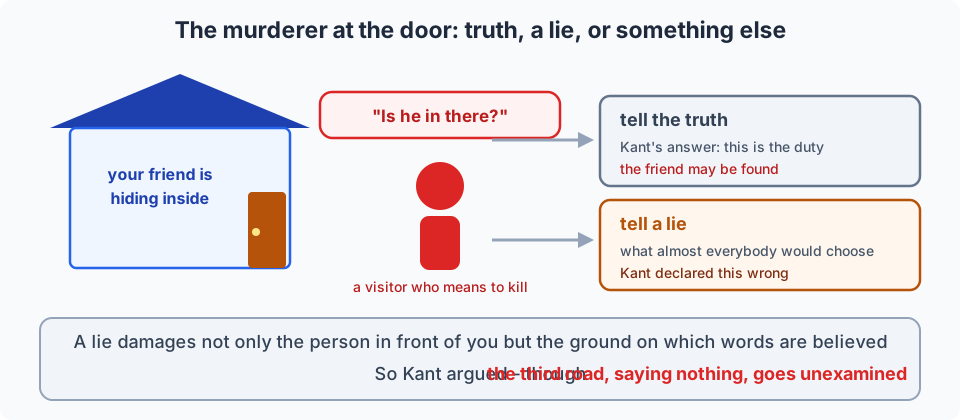
A friend rushes in, white-faced, and hides in your house. A little later there is a knock. You open the door to somebody plainly intending murder, who asks:
“Is he in there?”
What do you answer? Almost everybody lies without hesitating.
But in a short essay published in 1797, Immanuel Kant argued that even here you must not lie. It is one of the worst-regarded claims in the history of ethics; follow why he insisted on it, though, and something about the nature of rules comes into view.
An example raised as a criticism
The setup was invented in order to criticise Kant.
The French thinker Benjamin Constant raised it while examining the moral theories of the day (Constant did not name his target; Kant took it to be himself). His point:
Apply the principle “telling the truth is a duty” unconditionally and you must answer honestly here. Which is plainly absurd. So the duty needs a condition: you owe truth only to those who have a right to it.
A sensible, moderate proposal. Most people are satisfied by it.
Kant refused the amendment — and wrote a short essay to say so.
Kant’s answer
His claim is bluntly simple (the essay is “On a Supposed Right to Lie from Philanthropy”). Lying is wrong in every case. The duty of truthfulness is unconditional and admits no exception.
He gives two reasons.
First, lying damages language itself. In lying I am not merely deceiving the person before me. I am damaging the very foundation of society, that a statement can be relied upon. Contracts, testimony and promises all rest on words being believable. Beyond harming an individual, the lie is an injury to shared human life.
Second, consequences cannot be foreseen. This turns out to be a surprisingly practical point.
Suppose you lie and say “he is not here.” But unknown to you, your friend has slipped out the back. The visitor believes you, searches outside, and may run into him there.
If you answer honestly and a bad outcome follows, you are not held responsible, because it is an accident. Lie, and every consequence flowing from it is attributed to your act. Kant weighted that difference in where responsibility lies.
Almost nobody agreed
The conclusion has been overwhelmingly unpopular from publication to the present. The main objections:
It offends intuition too badly. An ethical theory is expected to account for our moral judgements. A theory producing a conclusion nearly everybody thinks is wrong is suspect on that ground alone.
It contradicts Kant’s own principle. Elsewhere he says never treat a person merely as a means. Yet answering honestly here comes close to offering up your friend’s life for your own moral cleanliness. Ask who is being used as a means and Kant’s answer looks bad.
It narrows the options to two. Truth or lie is an unnatural dichotomy. There is saying nothing, refusing to answer, closing the door. On Kant’s own reasoning the duty is discharged so long as you do not lie, so silence should be permitted. The essay barely considers the possibility.
The asker has no right. Back to Constant’s original point. Does somebody seeking information in order to do harm have a right to the truth? As a promise extracted under coercion is void, this demand need not be treated as a legitimate one.
Why it is still worth reading
Why read an argument so thoroughly criticised?
Because, I think, it pushes to the limit the question of what it means to admit an exception to a rule.
Admit one exception and the next question arrives: which cases are exceptions? When a life is at stake? What about serious injury? Property? Reputation? Admit exceptions without a criterion for drawing the line and the rule becomes something bent whenever convenient.
That is presumably what Kant feared. The moment cases where lying is permitted are conceded, the judgement passes to individual discretion. And people exercise discretion in the direction that suits them.
The worry is not misplaced. “This is a special case” has been used to excuse every kind of rule-breaking. But that does not make refusing all exceptions the right solution.
How Kant scholarship treats it now
Current research largely reads the essay as not a necessary consequence of Kant’s ethics.
One line distinguishes situations: an ideal state in which everyone follows the moral law versus a state in which wrongdoing is actually occurring, with the treatment differing in the latter. The murderer has already stepped outside the moral relationship, so ordinary duties may not apply unchanged.
Another treats the essay as a late instance of Kant swinging to an extreme, to be read apart from the arguments of his major works.
Either way, the general understanding now is that adopting deontology is not the same as accepting this conclusion.
Things people wonder about this problem
Has this situation actually arisen?
Repeatedly, throughout history. There are many records of people hiding the persecuted and lying to the authorities to protect them.
We praise those people. Hardly anyone condemns them for lying. That fact has itself been treated as strong evidence against Kant’s conclusion.
Does staying silent solve it?
In theory, though it often fails in practice. Silence is frequently read as confirmation. Refusing to answer can itself communicate that there is something to find.
Still, the mere existence of the option matters. Start the argument as a choice between truth and lie and options outside the frame become invisible. Doubting the options as presented is a useful move in ethical problems generally.
So how should one think about it?
The place to use this problem, I think, is the lesson “if you are going to allow exceptions, write the conditions down in advance.”
Judge in the moment and you will always lean the convenient way. That is why Kant allowed no exceptions. But if the conditions can be specified beforehand, discretion is not arbitrary. Either forbid exceptions or write the conditions for them. That, I think, is what the argument leaves behind: you must choose one of the two.
Related thought experiments
Articles where rules and consequences collide.



Summary
This article covered “The Murderer at the Door.”
Do not lie, even with a friend’s life at stake. Kant wrote out, head-on, a conclusion almost everyone rejects. And that his reason was “to protect the ground on which words are believed” shows his consistency.
You need not agree with the conclusion to keep the observation that the instant an exception is admitted, the question of who draws the line and how begins. Once you are the one making rules, that worry stops being somebody else’s.
To return to the full list of thought experiments, follow the link below.
Thank you for reading. We hope to see you in the next article.

Also popular with readers
📚 Series: Famous Thought Experiments (38/60)