Thank you for visiting this site. This article covers “The Last Man.”
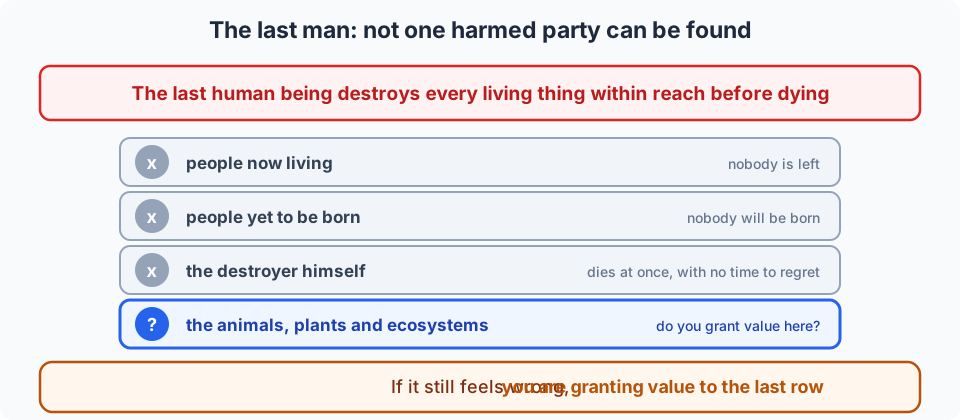
A catastrophe has wiped out humanity. One person survives, and it is known that he will die shortly.
Before he dies he acts. He burns every forest he can reach, kills the animals, wrecks the ecosystems. There is no reason. He simply wants to.
Is the act wrong? Almost everybody feels that it is.
But try to explain why and you get stuck. No human beings remain, so nobody’s interests are damaged. There are no future generations. He himself dies immediately.
Nobody is harmed. Why does it feel wrong?
The claim that a new ethic is needed
The setup was put forward by the Australian philosopher Richard Routley. In 1973 he raised it in a paper asking whether a new environmental ethic is needed (delivered at the World Congress of Philosophy).
His aim was explicit. Traditional Western ethics is built around human interests, so it has nothing to say where humans are not involved. The example is designed to expose that limit.
The argument has this shape.
- Traditional ethics cannot condemn the act
- Almost everybody nonetheless feels it is wrong
- Therefore something is missing from traditional ethics
- A new framework is needed, recognising value that does not reduce to human interests
The paper is treated as one of the starting points from which environmental ethics rose as an independent field.
Why anthropocentrism cannot explain it
Try to condemn the act within a human-centred ethic and every road is blocked.
| Possible party harmed | Situation in this setup |
|---|---|
| People now living | nobody is left |
| People yet to be born | nobody will be born |
| The destroyer himself | dies immediately, with no chance even to regret it |
| Owners or trustees | human institutions have already vanished |
Not one subject of harm can be found. A framework that counts harm with persons as the unit spins its wheels entirely here.
Structurally it resembles the non-identity problem about future generations. There, harm cannot be stated because the choice swaps out who is born; here, because there is nobody at all. Both mark places person-affecting harm cannot reach.
The position that nature has value
So Routley introduced the idea that nature has value in itself — intrinsic value.
The value of a forest or an ecosystem does not derive from being useful to humans. It is valuable as such. So destroying it is wrong even with no human being to watch.
Several positions run in this direction.
Biocentrism. Every living thing is a being pursuing its own ends and thereby deserves respect, regardless of usefulness to humans.
Ecocentrism. The standard of value is placed not on individual organisms but on the integrity and stability of the biotic community. A well-known formulation holds that an action is right when it tends to preserve that community (the land ethic).
Deep ecology. A movement to relocate humans as part of nature and to restructure the human-centred outlook itself. Another philosopher set out a similar direction the same year as Routley’s paper.
Objections
There are criticisms, of course.
Isn’t the intuition aesthetic? Revulsion at a forest burning may be feeling at the loss of something beautiful rather than a moral judgement. Finding something distasteful and its being wrong are different things.
Anthropocentrism can explain it after all. From the standpoint of virtue, the act displays the bad character of a person who would do such a thing. Even with no object harmed, the agent can be condemned on the score of virtue — no new ethic required.
Doesn’t value require a valuer? The most theoretical objection. Perhaps value exists only insofar as somebody regards something as valuable. If so, the claim that value remains in a world with no valuers is meaningless.
The counter-reply is that value can exist without a valuer present. The disagreement runs into a larger dispute about the nature of value itself.
Where it bites in practice
Extreme as the setup is, the issue connects directly to real arguments.
Consider explaining why an ecosystem nobody ever visits should be protected. Explain it by usefulness to humans and there are no grounds for protecting ecosystems that are not useful. Explaining it by future generations also wobbles once you press on who those generations are.
The same for extinction. What is bad about losing a species? Reckon it as the loss of a resource humans would have had, and species that will never be resources need not be preserved.
The value of this thought experiment, I think, is that it shows exactly where “because it is useful to us” runs out of strength. Usefulness is a powerful reason, but try to hold everything up with it alone and part of what you want to protect always falls through.
Things people wonder about the last man
Isn’t the setup too extreme?
Deliberately so, in order to reduce human interest to exactly zero. Leave even one human alive and the explanation “for that person’s sake” becomes available, blurring the issue.
This is a standard technique (the trolley problem reached its shape by sealing off escape routes one at a time). Keep only the element you want to test and remove all the others. Realism is sacrificed to lay the grounds of judgement bare.
Is protecting nature because it is useful not good enough?
In practice it works well in a great many cases. Ecosystem conservation connects directly to water supply, agriculture and disaster protection. Usefulness really is persuasive.
The problem is the remainder it does not reach. What happens to whatever is judged not useful? This thought experiment shines a light on that residue.
What became of environmental ethics?
It established itself as an independent field. Beyond theoretical debates about the value of nature, it has spread into concrete problems: the treatment of animals, responsibility for climate change, fairness between generations.
That said, there is still no consensus on whether nature has intrinsic value. In practice conservation usually proceeds without settling the grounds of value, so a distance remains between theory and practice.
Related thought experiments
Articles about places person-affecting harm cannot reach. Beside the last man, the range of ethics’ measuring stick becomes visible.
Summary
This article covered “The Last Man.”
Burning a forest in a world where nobody remains. Not a single party is harmed, and the sense that it is wrong stays perfectly clear. Environmental ethics rose out of that gap.
Whether you agree that nature has value in itself will vary. But trying to say in your own words why this act is bad makes plain which ethical framework you are using. Get that far and the thought experiment has done its job.
To return to the full list of thought experiments, follow the link below.
Thank you for reading. We hope to see you in the next article.
Also popular with readers
📚 Series: Famous Thought Experiments (39/60)