Thank you for visiting this site. This article covers the “Split Brain.”
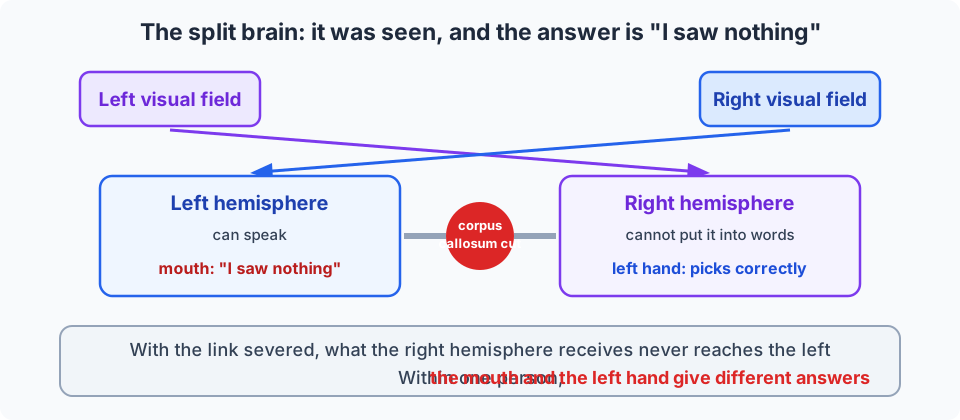
In one experiment, a picture of a spoon is flashed into the left half of a patient’s visual field. Asked “what did you see?” the patient answers “I saw nothing.”
Then, asked to pick up an object from the table with the left hand, his left hand takes the spoon without hesitating. Asked why he picked it, he cannot explain.
This is not a scenario assembled in someone’s head; it is the record of an experiment actually performed. The split brain in this article is not a thought experiment. It keeps being discussed alongside them, though, as a rare case where reality pushed an answer at the questions about self and consciousness that philosophers had been building in their heads.
The operation that separates left from right
The human cerebrum is divided into two hemispheres. (Look at it from outside and you can see the deep groove splitting it in two.) What joins them is the corpus callosum, a bundle of roughly 200 million nerve fibres.
Severe epileptic seizures spread through the whole body when abnormal electrical activity in one hemisphere travels across the callosum to the other. So for severely affected patients whose seizures did not respond to drugs, surgeons began cutting the corpus callosum to stop the propagation. It was attempted in the 1940s and performed again, in a refined form, in the 1960s.
The surgery achieved its aim. Seizures fell sharply and patients’ lives improved. And remarkably, after the operation patients appeared almost entirely normal in everyday life. Personality, intelligence and conversation were unchanged.
The effects of the separation showed only under specially arranged conditions in the laboratory.
How the experiment worked
The decisive experiments exploited the wiring of vision. Research in this area was recognised with a Nobel Prize in 1981 (in physiology or medicine).
Human vision has this property: what falls in the left half of the visual field goes to the right hemisphere, and the right half to the left hemisphere. Note that the split is not between the eyes but between the halves of the field of view.
And in most people the regions handling language are in the left hemisphere.
Normally, information received by the right hemisphere crosses the callosum to the left and can be put into words. Cut the callosum and that handover fails. So researchers presented pictures to one side of the visual field, too briefly for the eyes to move.
The results:
| Side presented | Hemisphere reached | Can it be said aloud? | Can the left hand pick it? |
|---|---|---|---|
| Right field | Left (has language) | Yes | No |
| Left field | Right (no language) | answers “I saw nothing” | picks correctly |
Presented on the left, the information reaches the right hemisphere. The right hemisphere controls the left hand, so the left hand grasps the correct object. Nothing reaches the language-bearing left hemisphere, so the mouth answers “I saw nothing.” Within one and the same person, the answers disagree.
The left hemisphere invents reasons
The most unsettling observation in this research is the following.
Show the instruction “walk” to the right hemisphere alone and the patient stands and walks. Ask “why did you start walking?” and the language-bearing left hemisphere answers — despite never having seen the instruction.
The patient does not fall silent. He fluently supplies a plausible reason such as “I was going to get a drink.”
In another famous task, a snow scene is shown to the left field and a chicken foot to the right. The patient picks a shovel with the left hand and a chicken with the right. Asked why, he explained “you need a shovel to clean out the chicken shed.” The left hemisphere saw only the chicken, so it forced an explanation of the shovel out of the information available to it.
Researchers named this the “interpreter.” The left hemisphere carries machinery for giving its own behaviour a coherent narrative. And that narrative, even when not based on fact, does not feel like a lie to the person telling it.
This observation is what the research is most widely cited for. When we feel that “I know why I did that,” do we really know the reason? Or are we reading out an explanation constructed afterwards?
Is consciousness one, or two?
Philosophy seized, naturally, on this: does a split-brain patient have two consciousnesses?
The two-consciousness position takes the experimental results at face value. Each side perceives independently, judges independently and does not know the other’s contents. It is natural to conclude that there are two subjects.
The one-consciousness position weights everyday life heavily. Patients do not feel themselves to be two people, and two wills almost never clash in daily living. If the separation appears only under special laboratory conditions, that falls short of evidence that consciousness has split.
The problem grew more complicated recently. Research in the 2010s reported that split-brain patients can, in some settings, respond to tasks spanning the visual fields. On that basis an interpretation was offered in which perception is divided while the subject of consciousness remains single.
That interpretation is disputed too, and the matter is unsettled. Which also means we do not yet have a yardstick for how consciousness is to be counted.
Reality caught up with the armchair
Philosophy’s debates about personal identity have long handled the thought experiment of transplanting each half of a brain into a different body. What keeps that setup from being dismissed as fantasy is split-brain research.
Experiments showed that the hemispheres can work independently. It is also known that a person can live with only one hemisphere. What was hypothetical is partly supported by actual observation.
The greatest value of this research, I think, is in learning that the unity of the self is not a given. We feel ourselves to be a single integrated being, and that feeling is itself produced inside the brain. Interfere with the machinery producing it and the feeling changes too.
Things people wonder about the split brain
Are the patients still suffering?
Impairment in daily life is reported as very slight in most cases. The surgical aim of suppressing seizures was achieved, and quality of life improved substantially.
The dramatic separation seen in experiments appears only under tightly controlled conditions. Ordinarily, moving the eyes brings both fields to both hemispheres, and the two sides can communicate indirectly through touch and through speaking aloud.
Full section of the callosum is performed less often now than before, since drug therapy and other surgical approaches have advanced.
Does the same thing happen in healthy people?
As for reasons constructed after the fact, yes, and widely. Many psychology experiments report people asked for the reasons behind their choices confidently giving explanations that differ from the actual cause.
What makes split-brain research special is that experimenters can plant information the person absolutely cannot access. That makes it possible to establish from outside that the explanation is invented. In healthy people, evidence that clear is hard to obtain.
What did the research give philosophy?
Two things, I think. One is that it made the question of the unit of consciousness concrete, giving the previously abstract “how many consciousnesses are there?” an example that resists counting.
The other is that it shook confidence in self-knowledge. The premise that you know your own reasons best underlies a great deal of ethics and law. The interpreter attaches a caveat to that premise.
Related thought experiments
Articles on the unity of the self and where consciousness resides. Placed next to the split brain, the connection between armchair argument and actual observation becomes visible.
Summary
This article covered the “Split Brain.”
Saying “I saw nothing” while the left hand picks correctly. That single observation dragged the question of how many consciousnesses there are out of philosophical speculation and into the laboratory. And the discovery of the interpreter opens a separate question: what are we actually doing when we take ourselves to be explaining our own behaviour?
The split brain gets discussed alongside thought experiments because it is a rare case of reality catching up with an extreme setup built in someone’s head. What was assumed to be hypothetical was happening in an operating theatre. That does not occur often.
To return to the full list of thought experiments, follow the link below.
Thank you for reading. We hope to see you in the next article.

Also popular with readers
📚 Series: Famous Thought Experiments (9/60)