Thank you for visiting this site. This article covers “The Extended Mind.”
On a day when you leave your phone at home, something feels off all day. The contacts are in it, so is the calendar, so is the map to wherever you are going.
Did you forget a tool? Or did you leave part of your memory at home?
In 1998 Andy Clark and David Chalmers took that difference seriously (Chalmers is also known for posing the hard problem of consciousness). Their claim is blunt: the mind does not stop at the skull. A tool meeting certain conditions should be counted as part of the mind itself.
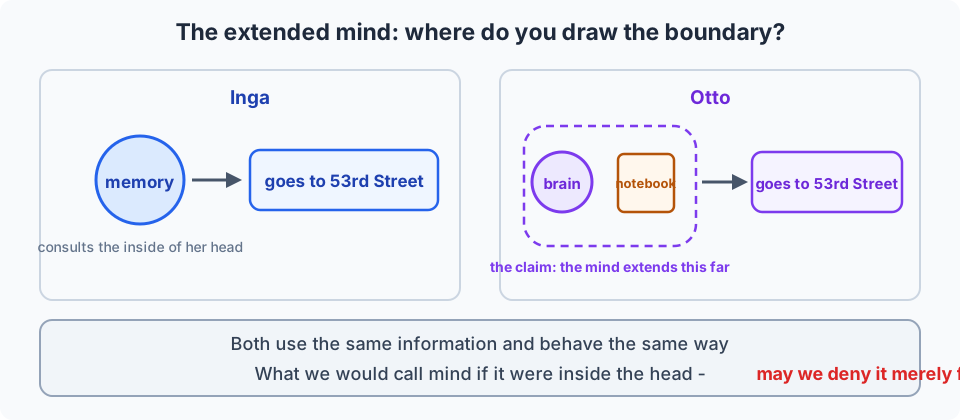
Two people going to a museum
The argument turns on a pair of characters set side by side.
Inga hears there is an exhibition at the museum. Trying to recall where it is, the memory surfaces that it is on 53rd Street. She sets off.
Otto has difficulty with memory. So he writes everything important in a notebook and carries it everywhere. Hearing the same news, he opens the notebook, confirms that the museum is on 53rd Street, and sets off.
Now, what is the difference between these two?
The behaviour is the same. The flow — consult the information, head there — is the same. The only thing that differs is whether the information consulted sat in the head or in the notebook.
Of Inga we would ordinarily say “she believed the museum was on 53rd Street.” What, then, should we say of Otto?
The parity principle
Clark and Chalmers introduce a rule at this point, known as the parity principle.
If a process would count as a cognitive process were it going on in the head, we should not deny it that status merely because it is going on out in the world.
Accept the rule and Otto’s notebook is part of his beliefs. The notebook plays exactly the role Inga’s memory plays, in exactly the same way.
Treating them differently purely on grounds of location means judging by where something is rather than what it does. They took that to be an unmotivated bias.
Not every tool qualifies
Even so, not every object around you becomes part of your mind. The paper lists rough conditions for a tool to count as belief.
| Condition | What it means |
|---|---|
| Constancy | It is always at hand and used routinely |
| Accessibility | It can be consulted without effort when needed |
| Automatic endorsement | Information retrieved from it is accepted without being questioned |
| Past endorsement | You checked and entered that information yourself at some earlier point |
Otto’s notebook satisfies all of these. He keeps it on him, opens it the moment he needs it, and does not doubt what is written there.
An encyclopedia you happen to open in a library does not satisfy them. It is not always at hand, and you did not write it. So it stays a source of information rather than a part of your mind.
The mind’s contents, out in the world
The argument resembles the externalism that came before it, but it is aiming at something else.
The claim that word meaning is fixed by connections to the outside world is about what a term got hooked up to in the past. What somebody meant by “water” in 1750 was settled by the environment of that time.
The extended mind claims instead that right now, at this moment, something outside is carrying out cognitive work. The notebook is not a matter of past circumstances; it is on active duty. To mark the difference, this version is called active externalism.
The interesting part, to me, is exactly that difference. What is being reopened is not the content of the mind but its physical extent.
The objection: how far does it spread?
Criticism came, naturally, and hard. The main lines:
Cognitive bloat. The most common reply. If a notebook is part of the mind, so is the laptop, so is the search engine, so is the colleague you are always with. A definition that expands without limit loses the power to distinguish anything.
The response is that the conditions above draw the line. To which the counter-reply is that those conditions are themselves vague.
External symbols have no intrinsic content. A more theoretical criticism. A state in the brain can be taken to mean something all by itself. Letters written in a notebook mean something only when there is a reader. Ignoring that difference and treating them alike, the objection goes, is careless.
Depending on something is not the same as containing it. That we depend heavily on tools is a fact. But if it is only dependence, it suffices to say the mind is embedded in its environment, without going as far as saying it has extended. If a more modest account handles the same phenomena, that is the one to take.
In the age of phones and search
The paper was written in 1998, when you could not yet look anything up on a device in your hand. The argument feels far more pressing now than it did then.
Psychology reports a tendency in which knowing you can search for something later, people do not remember the information itself but where to find it (sometimes called digital amnesia). One way to read this: the role of memory is shifting from holding contents to managing locations.
If we grant that Otto’s notebook is part of his beliefs, our devices may get the same treatment. And then some awkward questions follow.
- Is wiping somebody else’s device without permission an intrusion on their memory?
- Does confiscating a device amount to removing cognitive capacity?
- How far does information stored on a device belong to the person?
These are not idle speculation; they are actively debated. Where the boundary of the mind is drawn now connects directly to talk of rights and responsibilities.
Things people wonder about the extended mind
Does consciousness extend outward too?
No, and the distinction is carefully kept. What the argument covers is states with content, such as belief and memory, not felt consciousness itself.
The notebook does not feel pain, and it does not taste redness. Chalmers is also the person who framed the hard problem of consciousness, but the extended mind deliberately stays out of that territory. The restraint is what keeps the argument tractable.
Is it appropriate to use a person with memory difficulties as the example?
The setup did draw criticism on exactly this point. Still, the example was chosen because it makes vivid that memory in the head and a record outside it are doing the same job.
And the conclusion does not treat the person lightly. If anything the opposite: it pushes toward respecting the tools someone uses as part of their mind rather than as mere aids. That implication matters for thinking about how support should work.
Am I supposed to agree with this?
More than whether you agree with the conclusion, I think what matters is whether you can state a reason when you disagree.
If your ground is “it is inside the head,” you have to explain why location is what matters. That explanation is harder than it looks. The strength of the parity principle shows up when you try to rebut it.
Related thought experiments
Articles on where the extent and the content of the mind get settled. Placed next to the extended mind, you can see that drawing the boundary is the issue in all of them.
Summary
This article covered “The Extended Mind.”
Inga who uses memory, Otto who uses a notebook. Try to explain the difference between them and you notice that little comes out beyond “because it is inside the head.” The parity principle is a short argument that presses on that one point, and it shook an assumption about the boundary of the mind that had gone without saying.
It reads as more immediate now than when it was written. Keeping your schedule, your contacts and your directions on a device — do you call that convenience, or memory stored outside? Change what you call it and you change how it gets treated.
To return to the full list of thought experiments, follow the link below.
Thank you for reading. We hope to see you in the next article.
Also popular with readers
📚 Series: Famous Thought Experiments (10/60)