Thank you for visiting this site. This article covers “Mind Uploading.”
Suppose a brain is scanned in full detail and the connections and behaviour of its neurons are reproduced on a computer. On start-up, the being there has your memories, speaks in your manner, and says “looks like the transfer worked.”
So is that you? Or somebody else very like you?
The question looks technological and is in fact the old debate about personal identity. Amusingly, changing only the procedure for transferring flips most people’s intuitions. In that wobble, how we conceive of “self” shows itself.
The premise
Uploading requires one premise (substrate independence): the mind does not depend on the material realising it.
What the brain does, at bottom, is exchange information. Neurons receive signals and pass them on under conditions. Reproduce that web of relations accurately and the same mind appears, whether the substrate is carbon or silicon.
Some reject the premise, holding that consciousness is a property produced by the specific biological machinery of a brain, and that imitating its function in another material yields only matching outward behaviour. The disagreement is the central dispute in the philosophy of mind.
Nor is it settled how finely the reproduction must go. Is a map of neural connections enough, or is molecular behaviour required? Not knowing the required resolution is the largest unknown in the project.
All at once, or one at a time
Suppose the technology existed. There are two broad methods, and the fork in intuition is here.
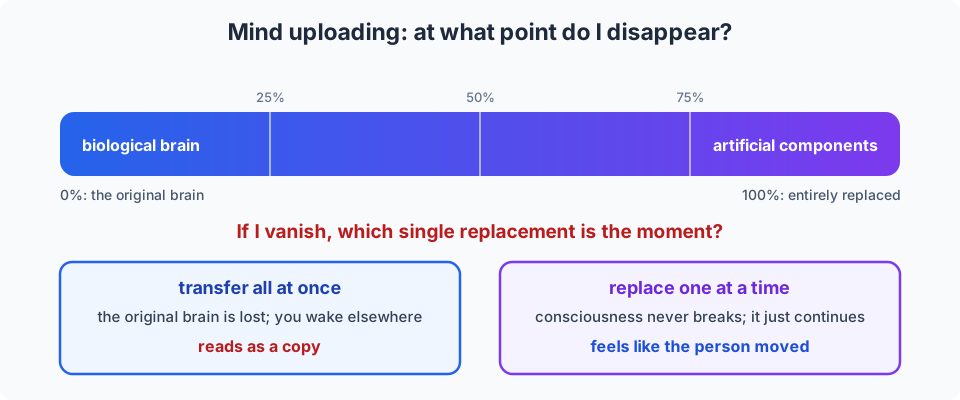
All at once. The brain is sliced and scanned precisely, and the resulting data boots a brain on a computer. The original brain is destroyed in the process.
Gradual replacement. One neuron is replaced by an artificial component with the same inputs and outputs. Consciousness is unbroken. Another the next day. Repeat for years, until the whole brain is artificial.
The end state is the same. And most people feel the first is “a copy was made” and the second is “the person moved.”
What changes as the steps get finer?
Where does the difference in intuition come from?
In gradual replacement, consciousness never breaks. Yesterday’s self connects to today’s, and the continuity holds to the end. So it feels like the person moved.
But an awkward question arises. If one a day is fine, what about a hundred million a day? What about all of them in a second? The step size varies continuously, so if there is a switch from “the person moves” to “a copy is made,” where exactly is it?
If you cannot point at the boundary, there is no essential difference between the two methods. Then either both preserve the person or both produce a copy. That existence or death is settled by the granularity of a procedure is hard to accept.
The structure is exactly that of the classic problem of removing grains one at a time from a heap (the sorites paradox): somewhere in a continuous change you must draw a line between being and not being.
Does consciousness come along?
Separately from identity there is another question: is the being running on the computer conscious at all?
Those who say yes appeal to gradual replacement. As neurons are swapped for artificial components one at a time, at which single replacement do the qualia vanish?
Vanishing abruptly would mean one component carried all of consciousness, which is implausible. Fading gradually means that, since function is identical, the person cannot notice, and you must accept consciousness fading while the person keeps reporting “I see it perfectly clearly” — an odd state. Both being unacceptable, it is more natural to hold that identical function means identical consciousness.
Those who say no reply that the argument presupposes that consciousness reduces to function. If you cannot rule out identical behaviour with nothing inside, the reasoning does not go through.
It is unsettled. And awkwardly, building an upload would not settle it, since the awakened being saying “I really am feeling things” is precisely the point at issue.
You can make as many as you like
Uploading has a difficulty peculiar to it, shared by neither teleportation nor fission: once you are data, you can be copied without limit.
Boot ten instances from the same data and which is the person? All have the same memories and all are certain they are the original. The concept of an original does not apply.
Practical questions follow.
| Question | What is at issue |
|---|---|
| Property and contracts | Which of the ten inherits the rights |
| Is deletion murder? | How to treat erasing the data |
| Data not running | Is stored-but-unbooted alive? |
| Different clock speeds | Has a fast-running instance lived longer? |
Economists have taken these seriously too. Posit a society with labour whose replication cost is near zero and wages and population behave in ways with nothing in common with our intuitions.
Where the technology stands
Apart from the philosophy, on feasibility: we are extremely far away.
A species of nematode has just 302 neurons, and a complete map of their connections was made in the 1980s (a soil-dwelling creature about a millimetre long). Its behaviour has still not been fully reproduced on a computer. A wiring map alone is not enough.
More recently the full connectome of a fruit fly brain was released, taking the scale to the low hundreds of thousands (still over four hundred times the nematode). The human brain has about 86 billion neurons and connections on the order of 100 trillion. The gap is not close.
That technical distance is, I think, exactly why the thought experiment can be enjoyed calmly. No decision is due tomorrow, so the premises can be examined at leisure.
Questions about mind uploading
Is gradual replacement really safe?
Many people feel so, and there is no guarantee it is right. The intuition that continuity preserves the person has never been verified.
There is even something like a counterexample. During sleep, consciousness is interrupted. And we take the person who wakes to be last night’s self. If continuity were truly decisive, people would be replaced every night.
If I upload just before dying, do I survive?
That is the great hope for uploading, and it is exactly what remains unresolved. What “survive” means has not been settled first.
If personal identity consists in psychological connections, you may say you survived. If this is a different thing from ordinary survival, you merely left behind a being very like yourself. The judgement rests on the theory of personal identity, not on technology.
Would I do it?
Honestly, at the present level of understanding I would not, for a simple reason: the awakened side reporting contentedly that it worked is no evidence of success.
Had it failed, the report would be identical. With a choice whose outcome cannot be checked, caution is all there is. That said, this is a preference rather than a factual judgement. Somebody reading the same arguments and reaching the opposite conclusion would not surprise me.
Related thought experiments
Articles on the conditions for remaining yourself. Beside uploading, you can see which issues are new and which are old.
Summary
This article covered “Mind Uploading.”
Transfer all at once and it reads as a copy; replace piece by piece and it reads as the person. Identical end state, opposite intuitions depending on the procedure — the most interesting thing here. And the fact that nobody can point at the boundary reflects the vagueness of our concept of the self.
Technically it remains distant. Discussing 86 billion neurons while 302 in a nematode still cannot be reproduced is getting ahead of ourselves. But working out the premises is not something you can do after the machine exists. A question worth thinking through now.
To return to the full list of thought experiments, follow the link below.
Thank you for reading. We hope to see you in the next article.
Also popular with readers
📚 Series: Famous Thought Experiments (59/60)