Thank you for visiting this site. This article covers “The Great Filter.”
The observable universe holds countless stars and an enormous number of planets around them. The universe is 13.8 billion years old, the Earth 4.6 billion. There has been ample time for other civilisations to arise and spread.
And the sky is silent. No radio signals, no probes, no traces of construction — nothing has been found.
One way of explaining the silence is the Great Filter: somewhere along the long road from matter to a galaxy-spanning civilisation there is a barrier that almost nobody gets through. And whether that barrier lies behind us or ahead reverses humanity’s prospects completely.
It starts with “where is everybody?”
The origin is a remark the physicist Enrico Fermi is said to have made over lunch in 1950 (small talk in a laboratory canteen, by tradition): “Where is everybody?”
By the numbers, other civilisations should be abundant. And there is not one shred of evidence. The discrepancy is the Fermi paradox, and explanations have been attempted ever since.
In 1996 the economist Robin Hanson proposed a framework for organising the problem, noting that getting from dead matter to a spacefaring civilisation requires passing through a series of stages in order.
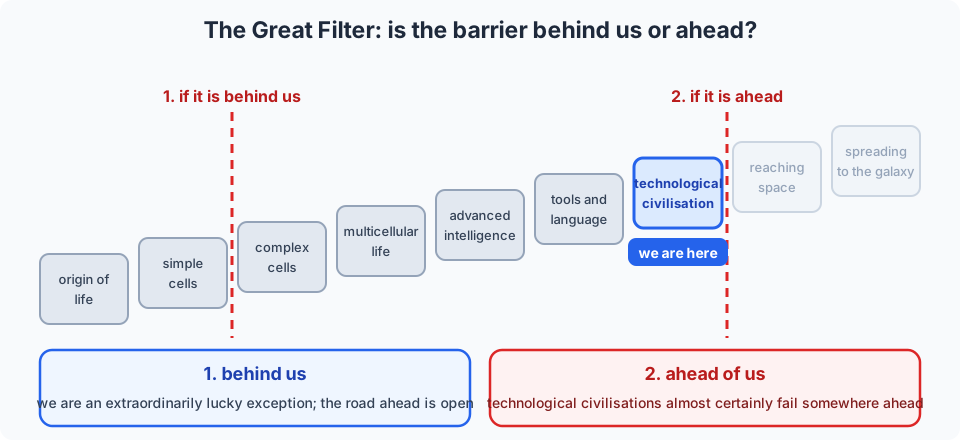
The stages that must be passed
Roughly, the stages are these.
- A planet forms with conditions suitable for life
- Self-replicating molecules appear (the origin of life)
- Simple cells arise
- Cells with complex structure arise
- Multicellular organisms appear
- Advanced intelligence appears
- A civilisation with tools and language is established
- Technology for reaching space is developed
- Expansion between stars, leaving traces
The overall probability of passing is the product of the probabilities at each stage. So if even one stage is extremely improbable, the final number is essentially zero.
If the observed silence is genuine, that product is in fact essentially zero. That is, some stage must be extremely hard to pass. Hanson called it the Great Filter.
Importantly, the argument does not identify where the barrier is. All that follows is that there must be one somewhere.
Behind us, or ahead?
Here the most disquieting part begins. We are currently around stage seven. Was the barrier before that point, or is it still to come?
| Position of the barrier | What it means | Our prospects |
|---|---|---|
| Behind us | We already passed it; we are the product of extraordinary luck | The road ahead is open |
| Ahead of us | Not yet reached; civilisations always fail beyond this point | We are near-certain to fail |
If it is behind us, we are an exception favoured by luck on a cosmic scale. Somewhere — the origin of life, the appearance of complex cells — a stage was unimaginably improbable and only we got through. Nothing in particular then blocks the way forward.
If it is ahead, the reverse. Everything up to our stage has been repeated over and over across the universe, and nobody has got further. Which points toward a mechanism by which technological civilisations reliably end themselves.
Which is why finding alien life is bad news
The framework yields a conclusion that looks strange at first: discovering life elsewhere is bad news for humanity.
The reasoning: suppose life that arose independently of Earth is found on Mars, or on a moon of Jupiter or Saturn. That is evidence that the origin of life is a common event in the universe.
Then the origin of life was not the barrier. The candidates behind us lose one member, and the probability that the barrier lies ahead rises. And the more complex the life discovered, the more the candidates behind us shrink.
So the more company we find in the universe, the darker our own future becomes. The discovery many people hope for turns, on this reasoning, into an omen.
Candidate barriers
Which stage is suspicious? The commonly cited candidates:
The origin of life. The process by which chemistry produces self-replication has never been reproduced. On the other hand, life appeared on Earth relatively soon after the oceans stabilised, which suggests it may not be so hard.
The appearance of complex cells. Cells with nuclei are thought to have arisen from simpler cells engulfing one another, and this event may have happened only once in Earth’s history. Simple cells persisted for nearly two billion years before it happened, once. A strong candidate.
Advanced intelligence. Earth has hosted diverse life for a very long time, and only one species built a technological civilisation. Intelligence is not necessarily advantageous and does not necessarily appear.
Self-destruction of technological civilisations. If the barrier is ahead, this is the favourite. Nuclear weapons, environmental destruction, badly designed artificial intelligence, mishandled biotechnology. The more powerful the technology, the more room there is for irreversible failure.
Explanations that need no filter
There are of course other explanations for the silence, requiring no barrier.
- Interstellar travel is too expensive, so nobody spreads
- Earlier civilisations deliberately avoid contact
- Our searching is biased (we look only for radio)
- The universe is still young and we simply arrived early
The last has been examined a good deal recently: the era when life develops around small, long-burning stars is still ahead, so on cosmic timescales we may be quite early.
The value of this thought experiment, I think, lies not in producing an answer but in organising what can be inferred from the fact that nothing has been observed. From the single datum of finding nothing, the argument goes this far — a model of how to think where material is scarce.
Questions about the Great Filter
Is this science or philosophy?
Both. Estimating stage probabilities can be argued from biology and astronomy. How to incorporate the fact that we are here as observers is a hard place in probability theory and philosophy.
Your own existence biases every observation. Only survivors can ask the question, so the frequency of past catastrophes gets underestimated. There is still no settled method for handling this.
If the barrier turns out to be ahead, what should we do?
Its exact location is not knowable, so the response is general: reduce irreversible failures.
Concretely, leave room to back out with technologies where one decision could end humanity. Make failures recoverable and the nature of the barrier itself changes. A pessimistic argument that nevertheless leaves a fair amount to act on.
Maybe there simply are no other civilisations?
Entirely possible — and that is itself one answer within the framework. The barrier is behind us and we are the only ones who passed just is the situation “there is nobody else.”
The Great Filter does not settle whether other civilisations exist. It is a tool for reading the observation that there are none, and so it includes that answer from the start.
Related thought experiments and paradoxes
Articles about our position in the universe. Beside the Great Filter, you can see the several ways the silence can be read.

Summary
This article covered “The Great Filter.”
From the single observation that the universe is silent, the argument concludes that some stage must be extraordinarily hard to pass — and its position reverses our prospects entirely. A great deal drawn from very little material.
Most striking is the conclusion that finding life elsewhere is bad news. The simple wish to find company in the universe becomes, inside this framework, a noose. Follow the reasoning to the end and you arrive somewhere other than where you hoped. That is when thought experiments are at their best.
To return to the full list of thought experiments, follow the link below.
Thank you for reading. We hope to see you in the next article.

Also popular with readers
📚 Series: Famous Thought Experiments (58/60)