Thank you for visiting this site. This article covers “The Doomsday Argument.”
A future in which trillions more humans are born and spread through the galaxy, against a future that ends within a few centuries. Being told that these can be compared without investigating the outside world at all sounds suspect.
One piece of reasoning claims to do it, using a single datum: the fact that I am here now.
The conclusion is disquieting. The chance that humanity ends soon is much higher than we suppose. Objections are many and nothing is settled, and identifying where it goes wrong is astonishingly hard.
Two urns
Check the skeleton on a simple case first.
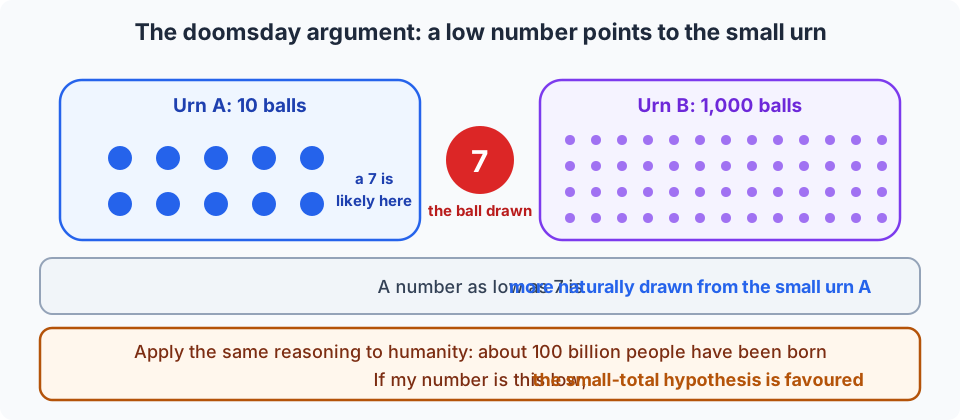
An urn sits in front of you containing numbered balls, and you do not know whether there are 10 or 1,000. Call the two possibilities equally likely.
You close your eyes and draw a ball. It reads 7.
Which urn is it? Intuitively the ten-ball urn seems likelier, and the arithmetic agrees. Drawing a 7 has probability 1/10 from the small urn and 1/1000 from the large one. Having drawn a low number favours the small urn by a factor of a hundred.
The doomsday argument applies that reasoning to humanity.
Using your birth rank
How many humans have been born is estimated from demography, and the figure usually quoted is about 100 billion (estimates vary by tens of billions across studies). So those of us alive now sit at roughly the hundred-billionth position in the whole human sequence.
Now a premise: I should regard myself as a random selection from all humans who have been born and will be born (the self-sampling assumption). If there is no reason to think you occupy a special position, assuming an average one is natural.
On that premise, compare two futures.
| Hypothesis | Total humans | How natural is my being 100-billionth |
|---|---|---|
| Ends soon | 200 billion | right about the middle; entirely natural |
| Long future | 100 trillion | one thousandth of the way in; far too early |
In a long future, the overwhelming majority of people born belong to the later part. Picked at random from that world I should be much further back. In fact I am very early.
So the short hypothesis explains the observation better — exactly the reasoning by which drawing a 7 makes you suspect the small urn.
Who proposed it
The argument was presented by the astrophysicist Brandon Carter in the 1980s and popularised in a book by the philosopher John Leslie. Around the same time another physicist independently published a slightly different version.
That version reasons about duration (sometimes the delta-t argument). Assuming the moment you observe a phenomenon is a random point within its lifetime, the remaining duration can be estimated probabilistically from the elapsed duration.
The form is easy to apply, and it has been tried on long-running plays and on corporate lifespans. Since results swing greatly with how the subject is chosen, its reliability as a forecasting instrument is disputed.
What it does not claim
To head off a common misreading: the argument makes no prediction of the form “humanity ends in year such-and-such.”
All it does is revise the ratio of plausibility between hypotheses. Somebody who started out strongly believing in a long future may still believe in one afterwards. It acts as pressure pushing the starting estimate toward the short side.
It says nothing about the cause either. Nuclear war, climate, plague, or simply a quiet decline in population — it is only about numbers.
The main objections
Many objections have been raised. The strong ones:
A random one of whom? The deepest is the reference class problem. Am I a random member of Homo sapiens? Of all conscious beings? If humanity evolves into another species, do the descendants count in the same class?
Move that line and the conclusion moves substantially. And no principle for drawing it has been supplied.
Existing is itself information. Another strong reply swaps the premise: the fact that you exist favours worlds with more observers.
In a world where many people are born, your chance of existing at all is greater. Include that effect in the calculation and it is known to cancel exactly against the boost to the short hypothesis. Which assumption to adopt is still unsettled.
Past users would have been wrong. Suppose an ancient Roman had used the argument. Their birth rank was a few tens of billions, and the same reasoning would have concluded that humanity was about to end. It did not.
The reply is that a probabilistic argument naturally produces people it misleads. Even so, its property of generating alarm at every use while remaining unverifiable persists.
How to handle a growing population. People living during rapid population growth all feel themselves to be early. How to correct for that bias is another point of contention.
Why it will not go away
Why does the argument survive all this?
Because, I think, no other example shows so vividly how hard it is to treat yourself as observational data.
In ordinary science the observer stands outside the world and looks at an object. Try to use your own existence as evidence and the footing immediately becomes suspect, since there is no right answer to the question which population am I a member of.
The same difficulty appears in cosmology. In asking why the universe’s properties suit life, we must always handle the bias that observation is only possible from places where observation is possible. The doomsday argument extracts that difficulty in its minimal setting.
Things people wonder about the doomsday argument
So when does humanity end?
The argument cannot say. It moves ratios of plausibility between hypotheses and contains no machinery for producing an absolute number of years.
Figures do get quoted, and they depend heavily on the prior probabilities assumed and the reference class chosen. Change the premises slightly and the answer changes, so they should not be taken as concrete dates.
Isn’t the reasoning wrong somewhere?
Many people feel so, and many papers have been written trying to locate the error. There is no agreement on where it is.
Some attack the reference class, some swap out the assumption, some criticise the handling of probability. That the criticism does not converge is itself a sign of the argument’s toughness.
Does it affect what I should do?
I do not think it yields a direct guide to action. Even granting a high probability of ending soon, it says nothing about what to do.
What is useful is the question underneath: what biases are contained in the fact that you were able to observe at all? Studying only surviving companies and drawing lessons about success is a similar error. Wherever you are inside the observed set, this caution applies.
Related thought experiments and paradoxes
Articles on the difficulties of putting your own existence into a probability calculation.


Summary
This article covered “The Doomsday Argument.”
Draw a 7 and suspect the small urn. Apply that ordinary inference to humanity and our being early becomes evidence that the total is small. The only material is your own existence — no telescope, no statistics.
Several objections stand. None is decisive, and even where to aim the criticism is unsettled. The moment you include yourself in the observational data, probability becomes very hard to handle. What this argument really demonstrates is that difficulty, rather than any prophecy of the end.
To return to the full list of thought experiments, follow the link below.
Thank you for reading. We hope to see you in the next article.
Also popular with readers
📚 Series: Famous Thought Experiments (60/60)