Thank you for visiting this site. This article covers “Russell’s Teapot.”
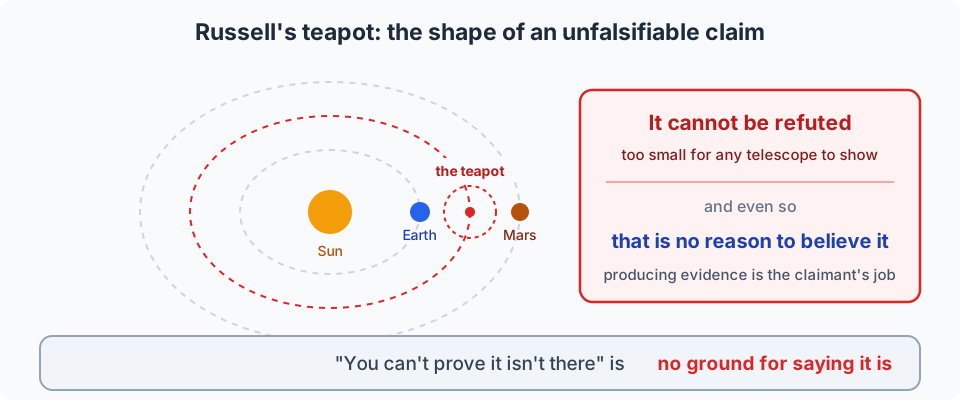
Between Earth and Mars, a china teapot orbits the sun. It is so small that not even the world’s best telescope could find it.
Can you refute the claim? No. However long the search comes up empty, “it is simply too small to see” disposes of the result. So should we believe in the teapot?
Bertrand Russell produced the odd example to make one point: being unrefutable and having reasons in your favour are different things. A brief image, and it teaches a good deal about how arguments should be conducted.
An article that was never published
The image was written in 1952. A magazine commissioned Russell to write on the subject “Is There a God?” and the teapot appears in the piece he produced (the commission came from a popular illustrated magazine). Ironically the article went unpublished at the time and appeared later in his collected works (no reason for the decision has come down to us).
What Russell wrote runs roughly as follows.
If I were to suggest that between the Earth and Mars there is a china teapot revolving about the sun in an elliptical orbit, nobody would be able to disprove my assertion provided I were careful to add that the teapot is too small to be revealed even by our most powerful telescopes. But if I were to go on to say that, since my assertion cannot be disproved, it is intolerable presumption on the part of human reason to doubt it, I should rightly be thought to be talking nonsense.
The key is that Russell does not attempt to disprove the teapot. What he points at is a procedural matter: which side carries the burden of proof.
Which side has the burden?
In an argument there is a party making a claim and a party hearing it. The obligation to produce evidence belongs to the claimant.
The teapot shows that truism in an extreme form. If I assert “there is a teapot in orbit,” producing evidence is my job. Pressing “if you can’t prove there isn’t one, there probably is” onto the other party is simply passing the obligation over.
That move is what logicians call the argument from ignorance (concluding truth from not knowing). A state of not knowing is no ground for either conclusion, and the manoeuvre uses it as support for one of them.
The same structure shows up constantly. “It hasn’t been proved safe, so it’s dangerous.” “It hasn’t been proved ineffective, so it works.” Identical in form, both using ignorance as evidence. The teapot is a yardstick for spotting the shape at a glance.
The harsher line Russell wrote next
The image has a continuation, which is the part that lands hardest for me.
Russell adds: if the existence of this teapot were set down in ancient books, taught as sacred truth every Sunday, and instilled into children at school, the matter would look entirely different.
In that society, the person who doubted the teapot would be the eccentric. The sceptic would be sent to a psychiatrist, or in an earlier age to the Inquisition. Nothing about the content of the claim has changed; only its treatment has flipped.
So what Russell is pointing at is not only the content of a claim. It is the social machinery by which the same content, repeated, authorised and implanted early, makes asking for evidence itself an impertinence. Read without this part, the image gives you only half its flavour.
The descendants
The teapot has been remade many times. The famous ones:
| Image | Content |
|---|---|
| A dragon in the garage | I have a fire-breathing dragon in my garage, but it is invisible, its heat cannot be measured, and it leaves no footprints |
| The Flying Spaghetti Monster | A creator in the shape of pasta made the universe; born in a dispute over public education |
| The Invisible Pink Unicorn | A being deliberately built with a contradiction: invisible, and known to be pink |
The dragon in the garage is especially good because the pursuit is written out. Told the dragon is invisible, you reach for infrared. Told it gives off no heat, you scatter powder to catch footprints. Each time a new excuse is added and one more handle for testing disappears.
And the question is left standing. A dragon that cannot be seen, touched, measured or traced — what distinguishes it from no dragon at all? The passage depicts a claim losing its content through the accumulated modifications made to keep it from refutation.
May God and a teapot be treated alike?
There are objections, of course. The most substantial is that the two are not in the same situation.
The teapot is something Russell invented on the spot. There is no reason to believe in it other than that he said so. Arguments about God’s existence, by contrast, are said to come with support independent of the image: arguments about why a universe exists at all, arguments about the grounds of morality, the religious experiences many people report.
There are also positions that question the structure of belief itself: not every belief is supported by inference from other beliefs. That other people have minds, that the past was real, that an external world exists — we accept these without proof, and the argument asks whether belief in God can be placed among such basic beliefs.
To which the counter-reply is “then why can the teapot not be a basic belief?” The exchange is not settled.
I take the teapot’s range of application to be limited to situations where somebody demands belief on the ground that a claim cannot be refuted. Bringing it out against an interlocutor arguing from other grounds is changing the subject.
Questions people raise about the teapot
Is the image a proof of atheism?
No. Russell does not prove “God does not exist.” What he shows is a procedural point: demanding belief on the ground of unrefutability is illegitimate.
Russell described himself, strictly speaking, as an agnostic on record. Granting that God’s nonexistence cannot be proved, he held that with no evidence there is no reason to believe. Proof and having a reason to believe are separate matters.
Do all unfalsifiable claims get treated the same?
No, and this is easily misunderstood. Unfalsifiable claims still differ in how likely they were to begin with.
A teapot in orbit has no imaginable route to being there, so its prior is extraordinarily low. A particle predicted by an existing theory but not yet observed is treated differently even while unrefuted. Throwing everything into one box on the strength of “unfalsifiable” alone is overusing the image.
Where is it useful day to day?
The typical case is being pressed with “can you prove it isn’t?” When that shape appears, suspect that the burden of proof has been flipped.
Getting the argument back is not hard. Just ask: “tell me why you think it is so.” You need not deny their claim; simply restoring the order in which evidence is produced moves things along. Acquiring that one move is the practical dividend of knowing the teapot.
Related thought experiments
Articles approaching from other angles the question of what to do with claims that can be neither proved nor refuted.


Summary
This article covered “Russell’s Teapot.”
An invisible teapot in orbit looks like a joke and works as an excellent instrument, conveying the etiquette of argument in a single picture. Unfalsifiable is not a reason to believe. That one point lets you spot arguments from ignorance across a wide range.
And the second half, on indoctrination, is hard to forget. The same claim, taught often enough, makes doubting it the rude act. That what gets believed is settled by treatment rather than content applies well beyond religion, all around us.
To return to the full list of thought experiments, follow the link below.
Thank you for reading. We hope to see you in the next article.

Also popular with readers
📚 Series: Famous Thought Experiments (43/60)