Thank you for visiting this site. This article covers “The Problem of Evil.”
Suppose there is a God who knows everything, can do anything, and is perfectly good. Then why does this world never stop producing events like the senseless suffering of children?
The question has been repeated for more than two thousand years. For believers and non-believers alike it is the least avoidable sore point in arguments about religion. The field called theodicy exists entirely as a response to it.
There is no answer. But where exactly the difficulty lies has been mapped in remarkable detail. Here is that map.
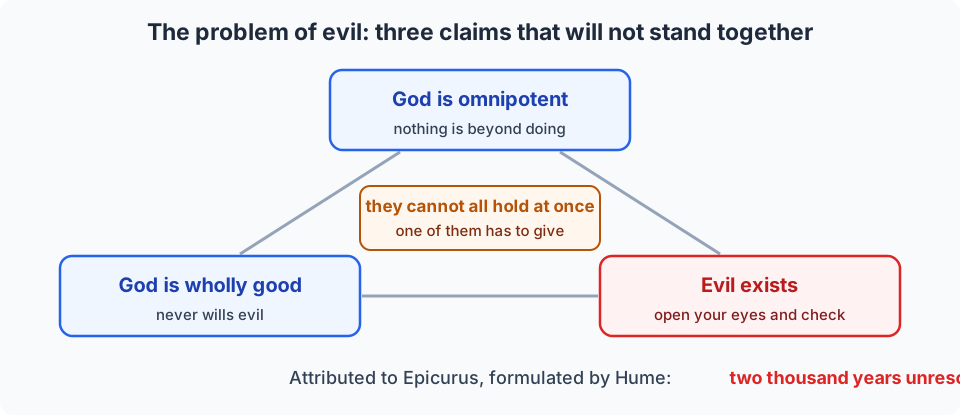
Three claims that will not stand together
The oldest form is attributed to the ancient Greek philosopher Epicurus. Strictly it comes down through a later writer under his name, and whether the words are his is doubtful. It remains the best statement of the skeleton of the question.
Arranged as Hume quoted it in the eighteenth century:
Is God willing to prevent evil, but not able? Then he is not omnipotent. Is he able, but not willing? Then he is malevolent. Is he both able and willing? Whence then is evil?
That is, these three claims appear unable to hold at once.
- God is omnipotent (nothing is beyond doing)
- God is wholly good (never wills evil)
- Evil exists
The third can be confirmed by opening your eyes. So the pressure is toward letting go of the first or the second.
Two problems of evil
Modern discussion splits the problem in two. Knowing the distinction tidies the argument considerably.
| Kind | Strength of claim | What it aims to show |
|---|---|---|
| The logical problem | Strong | The three claims are logically inconsistent, so God does not exist |
| The evidential problem | Weaker but tougher | No contradiction, but the amount and kind of evil make God’s existence unlikely |
The logical version was presented rigorously in the mid-twentieth century, taking the premise “if an omnipotent, wholly good being existed there would be no evil” and deriving a contradiction.
That version is now generally regarded as settled, because the free will defence described below is widely taken to have shown compatibility.
The evidential version took its place at the centre: “granted there is no contradiction, but this much suffering weighs as evidence that God does not exist.” It sounds weaker than a charge of contradiction and is in fact harder to answer.
The free will defence
The decisive reply to the logical problem was the free will defence.
The line of argument: God chose to create beings with free will. Free will means being able to choose good or evil. Granting freedom while leaving no possibility of choosing evil is impossible even for omnipotence — like “make a square circle,” a failure of the demand rather than of the power.
And a world containing free beings is more valuable than a world containing only puppets. So God chose a world including the possibility of evil. On that account the three claims are consistent.
Note what the reply establishes: only that God could have a reason for permitting evil. It does not prove that this is the reason. But since the side claiming logical inconsistency must show that no reason whatever is possible, offering one possibility suffices as a rebuttal.
The hard case: natural evil
The defence has an obvious limit. Earthquakes, tsunamis and epidemics are nobody’s free choice.
Evil done by humans is called moral evil and can be explained by freedom. Suffering caused by nature is called natural evil, and the explanation does not reach it. Talking about free will to a child suffering from a congenital illness gets nowhere.
This is where the evidential problem has its force. A frequently cited case is a fawn caught in a forest fire started by lightning, dying in agony where nobody will ever know. That suffering protects nobody’s freedom, contributes to nobody’s growth, and is witnessed by nobody. What purpose could this one event possibly serve?
The main theodicies
Responses have been offered anyway. The representative ones:
Soul-making. This world is designed not as a comfortable paradise but as a place where people grow. In a world without hardship, courage, compassion and patience never develop. Virtues need the situations that call for them.
Sceptical theism. We lack the capacity to see the reasons God may have. “No reason is apparent” does not mean “there is no reason” — a direct counter to the evidential problem. Pressed hard, though, it entails that we cannot judge God’s goodness either, which costs the believer something too.
The best possible world. God chose the best of all possible worlds. Evil is here because removing it would make the whole worse. After a great earthquake in the eighteenth century this view was savagely satirised (the Lisbon earthquake, which killed tens of thousands).
Evil as privation. An old idea on which evil is not a substance but the absence of good, so God did not create evil. To the person suffering, however, it makes no difference whether it is an absence or a substance.
In Eastern religions the shape changes
It is worth noting that the problem is specific to religions positing a single, omnipotent, wholly good God.
In dualist systems where a good god opposes an evil one, the existence of evil needs no explanation: the other side is doing it. In systems built on karma and rebirth, suffering is placed as the result of past deeds, so it does not take the form of an omnipotent being’s responsibility.
So the problem of evil appears as the price of setting the divine attributes so high. A God neither omnipotent nor wholly good raises no such question. That, I think, is the perspective that most clarifies the whole subject.
Questions about the problem of evil
Does the argument prove atheism?
No. The logical problem is widely taken to have been rebutted, and the evidential problem makes God’s existence unlikely rather than disproving it.
Nor has theism supplied a complete explanation. Many theologians hold their faith while admitting that a residue cannot be explained. Both sides go on looking at the same unresolved problem.
May one recite theodicy to somebody who is suffering?
A question outside philosophy, and an important one. Theodicy handles the consistency of a theory; it is not a response to the suffering in front of you.
For a third party to announce “your suffering has a meaning” can be an injury rather than a comfort. Religious practice has warned against it repeatedly. Strength as a theory and permissibility as something said aloud to a person are measured on different scales.
Is it worth thinking about if you have no faith?
I think so. The skeleton has the general form “demand several desirable properties at once and they stop being compatible.”
Can you build an institution that is perfectly free, perfectly safe and perfectly fair all at once? The same shape of question turns up constantly in design. You cannot proceed until you decide which to weaken — a structure the problem of evil shows in its most extreme instance.
Related thought experiments and paradoxes
Articles on divine attributes and the difficulties they generate. Beside the problem of evil, the weight of omnipotence and perfect goodness becomes visible.
Summary
This article covered “The Problem of Evil.”
Omnipotence, perfect goodness, the existence of evil — one of the three appears to have to go. That simple shape has been argued over for two millennia, I think, because every way of letting one go costs dearly.
The free will defence dissolves the logical contradiction and loses its force in front of a natural disaster. Soul-making handles the suffering of animals and infants badly. Every response leaves something unfilled somewhere. The question is better made than any of the answers — the fairest thing to say about this problem.
To return to the full list of thought experiments, follow the link below.
Thank you for reading. We hope to see you in the next article.

Also popular with readers
📚 Series: Famous Thought Experiments (44/60)