Thank you for visiting this site. This article covers “The Five-Minute Hypothesis.”
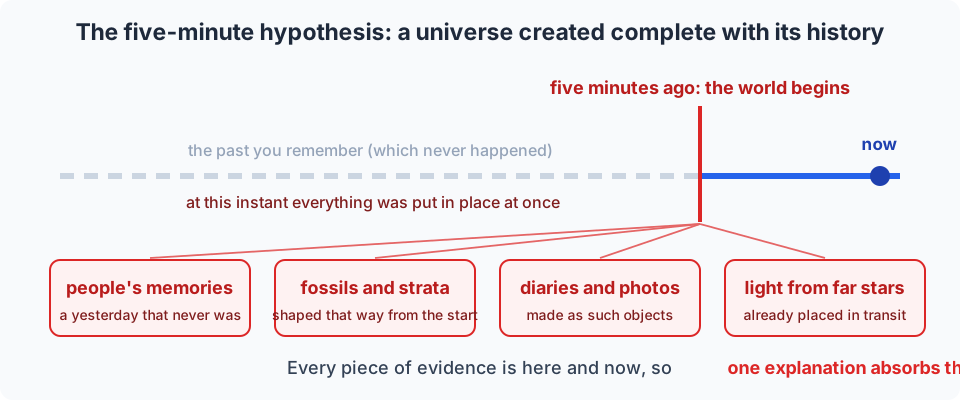
This world may have sprung into existence five minutes ago, exactly as it now stands. The half-eaten breakfast, the half-read book, the fossils buried in the strata — all of it placed there five minutes ago. And inside people’s heads, memories of a past that never once occurred, written in from the beginning.
Can you refute the hypothesis? Probably not. Everything you can produce as evidence that the past existed is something you have in your hands at this moment. Bertrand Russell tossed the point off in a sentence, and a century later it is still not tidied away.
What Russell was actually after
The hypothesis appears in The Analysis of Mind, published in 1921 (not a book about scepticism — its content is closer to psychology). In a chapter on memory sits a sentence to this effect.
There is no logical impossibility in the hypothesis that the world sprang into being five minutes ago, exactly as it then was, with a population that “remembered” a wholly unreal past.
The important thing is that Russell was not asserting this seriously. What he wanted to show was much narrower.
“Memory as it is now” and “events that happened in the past” can be prised apart logically. That is the whole of his point. However vivid a memory is, however specific in its details, however well it agrees with other people’s testimony, all of that is a fact about the present state of things. None of it touches the past itself.
So any attempt to prove the past existed on the strength of memory goes in a circle. To say “there is a past because memory is reliable” you have to establish somewhere that memory is reliable, and the only means of establishing it is memory again.
All the evidence is inside “now”
The awkwardness of the hypothesis becomes plain the moment you go looking for a counterexample. Line up what we can offer as evidence that the past was real.
| Evidence offered | How the five-minute hypothesis handles it |
|---|---|
| Your own memory | Written in as memory five minutes ago |
| Diaries and photographs | Made as such objects five minutes ago |
| Fossils and strata | Placed in that shape five minutes ago |
| Other people’s testimony | They were made five minutes ago too, memories included |
| Light from stars thousands of light-years away | Already positioned in the intervening space five minutes ago |
Every item on the list shares the property of being here now, so a single explanation disposes of the lot. We have no method for inspecting a past event directly. What we can get hold of is always a present trace.
This is the same argument in shape as the brain in a vat and Descartes’ deceiving demon. Those ask about space — “is there really a world out there?” — while this one asks about time: “was there really a past?”
What to do with an unfalsifiable hypothesis
What these hypotheses have in common is that they are built so that no observation can refute them. Any would-be refutation gets absorbed on the spot.
Seen from the side of science, that is a disqualification rather than a merit. To be a scientific hypothesis, a claim must take the form “if this observation came out, the hypothesis would be shown to be wrong.” A claim that stands firm whatever you observe says nothing about the world.
That said, this is not a proof that the five-minute hypothesis is false. It is only a ruling that the hypothesis is not a subject for science. Russell himself offers no argument that it is false.
There is nothing special about five minutes
Another observation captures the character of the hypothesis well: the number five has no grounding whatever.
The same argument works word for word with five seconds, last Thursday or ten thousand years. There is even a name mocking the structure — Last Thursdayism — on which the world was created last Thursday, complete with every historical record.
That the boundary can go anywhere is the flip side of the fact that the hypothesis says nothing concrete at all. There is in principle no material for ruling that five minutes ago is right and five seconds ago is wrong. I take this to be the easiest foothold for anyone who wants to dismiss it.
A twin out of theology
A similar idea came from somewhere other than philosophy. In the mid-nineteenth century, when reconciling the vast ages implied by geology with the biblical account was a live problem, a naturalist proposed the following.
God, when he created the world, created it looking as though it already had a history (the Omphalos hypothesis). Strata, fossils, tree rings — all present in that form from the start. The name comes from the question of whether the first man had a navel (a navel being evidence of having been joined to a mother, which the first man would not have needed).
The proposal pleased neither side. Science dismissed it as unfalsifiable; the faithful found it hard to accept because it makes God the author of an enormous body of fake evidence.
Structurally it is identical to the five-minute hypothesis. Detach apparent age from actual age and any evidence can be neutralised. Put the two side by side and both the power and the emptiness of the manoeuvre come into view.
Why we believe in the past anyway
So how should one respond? Three of the stronger replies.
Compare the weight of the explanations. To make the five-minute hypothesis work, you must posit something that arranged memories, fossils and distant starlight so as to be mutually consistent. Supposing there was simply a past explains the same phenomena with far fewer assumptions. By the principle of not multiplying assumptions, the ordinary explanation is the one to take.
Look at what the words mean. The meanings of “past” and “remember” were acquired through uses actually tied to past events. If there is no past at all, the very words used to state the hypothesis lose their meaning. The objection is that the hypothesis digs away its own footing.
Look at it from practice. Even if the five-minute hypothesis were true, nothing about how we act would change. Promises should still be kept, debts still repaid. The world looks and behaves exactly as it would if there had been a past. The question becomes how seriously a hypothesis that changes nothing needs to be taken.
Questions about the five-minute hypothesis
Is it true or false, in the end?
The accurate answer is that it cannot be decided either way. It contains no logical contradiction, so it cannot be dismissed on those grounds alone. Nor is there a single reason to believe it.
Russell’s aim was not to settle its truth but to make us notice that the confidence we have about the past is placed there as an assumption, not a proof. It is a device for showing how much of what underlies our thinking is believed without proof.
If memory cannot be trusted, does history collapse?
It does not. What history deals in is whether several independent lines of evidence support one another, not a proof that the past was real.
Since the five-minute hypothesis invalidates all evidence uniformly, it makes no difference at all to the relative standing of one piece of evidence against another. Source criticism and dating methods work exactly as before. Scepticism that doubts everything equally has no purchase on particular judgements.
What changes once you know this thought experiment?
The biggest gain, I think, is acquiring a feel for the fact that a claim built to be irrefutable is not strong but empty.
When you run into an explanation that swallows every objection, the response is not to admire its reach but to ask back: “what does this predict?” and “where could it come out wrong?” The five-minute hypothesis is a well-made practice ground for that.
Related thought experiments
Thought experiments about the worry that reality or the past is not as it appears. The same structure, aimed at different targets.

Summary
This article covered “The Five-Minute Hypothesis.”
Try to prove the past was real and you are always left leaning on traces available here and now. That single point is enough to make the hypothesis immune to refutation. Russell was not out to mount a grand sceptical programme; he put the extreme case there to sharpen a point about memory.
But as a by-product, the hypothesis buys you very cheaply a feel for the fact that “cannot be refuted” and “has reasons in its favour” are entirely different things. That usefulness is why a sentence from a hundred years ago is still being quoted.
To return to the full list of thought experiments, follow the link below.
Thank you for reading. We hope to see you in the next article.

Also popular with readers
📚 Series: Famous Thought Experiments (23/60)