Thank you for visiting this site. This article covers “The Allegory of the Cave.”
There are people who have been bound at the back of a cave since birth and have seen nothing but the shadows on the wall in front of them. For them those shadows are the whole world. So what happens if one of them is unbound and taken outside?
Plato told this story in the Republic in the fourth century BC, and it is one of the most famous scenes in Western philosophy. The question “is the reality we see the real one?” runs straight from here to The Matrix 2,400 years later. What the allegory was really about, though, was less the fakeness of reality than what education is.
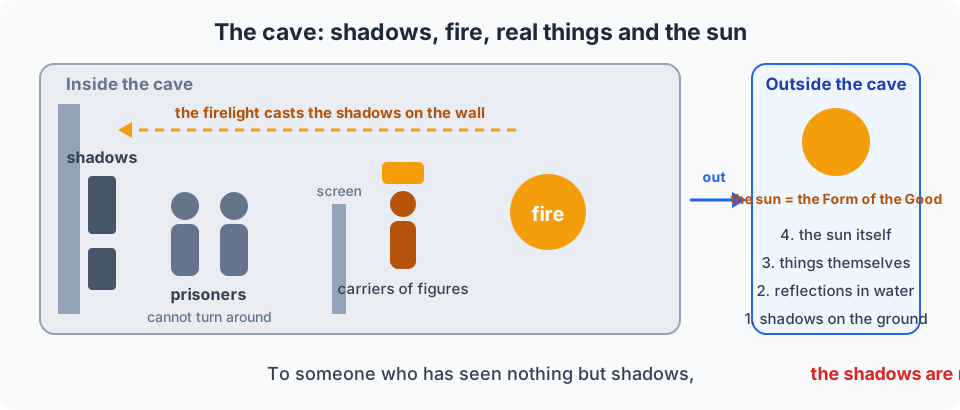
What is inside the cave
Start with the staging. In Book VII of the Republic, the story is told by Socrates to his pupil Glaucon (Glaucon was in fact Plato’s own brother).
People live in an underground cave. They have been bound at the neck and legs since birth and cannot turn around. All they can see is the wall in front of them.
Behind the prisoners a fire burns up high. Between the fire and the prisoners is a low screen, and people pass back and forth on the far side of it, carrying tools, figures and statues of animals above their heads. Only the shadows of these things, cast by the firelight, appear on the wall ahead.
The prisoners have never once seen anything else. They watch the shadows of the figures being carried past, and when a voice echoes they take the shadow to have spoken. For them “the assembly of shadows on the wall” is the only reality there is.
At this point Plato adds a line: these prisoners are just like us.
What happens when one is unbound
Now suppose one of them is released and made to stand up and turn around.
The first thing that happens is not wonder but pain. Turning his head he faces the fire, too bright for eyes accustomed to darkness, and he sees nothing. Even when the real objects come into view and somebody explains “what you were looking at were shadows of these,” he is not convinced. If anything, Plato writes, he takes the shadows he could see clearly to be the truer things.
Dragged out of the cave by force, matters get worse. The sunlight dazzles him and he can see nothing at all. From there his eyes adjust in stages.
- First he can make out shadows cast on the ground
- Then reflections in water
- In time, the objects themselves, seen directly
- At night he can look up at the moon and the stars
- Finally he can look at the sun itself, by day
And then he understands: the sun is what brings the seasons and the years and is the cause of everything visible. The shadows he watched in the cave were a thin trace of that same light after many removes.
This picture — not leaping straight to the truth but adjusting in the order the eye can bear — is to my mind the most realistic part of the allegory.
The one who returns is laughed at
The allegory continues. The one who has seen the outside goes back into the cave.
But entering the darkness, eyes now used to brightness can no longer make out the shadows. At the game of guessing which shadow will appear next, he loses to his fellow prisoners.
Seeing this, they say: “he went up and came back with his eyes ruined.” So nobody should go out at all. And if anyone tried to unbind them and lead them up, Plato writes, they would seize him and kill him.
The allegory does not stop at epistemology. For Plato, someone who had learned the truth, come back, gone unheard and been killed was not hypothetical. It was his teacher, Socrates, sentenced to death on a charge of “corrupting the young.” That figure is laid over this ending.
What the shadows and the objects stand for
The allegory is paired with the analogy of the sun and the divided line that precede it (the three form a single continuous argument), and it is there to explain Plato’s theory of Forms. The correspondences run like this.
| In the allegory | What it stands for |
|---|---|
| Shadows on the wall | The shifting particular things the senses take in |
| The figures and tools casting them | The patterns those things are based on |
| The fire in the cave | The limited light illuminating the sensible world |
| Things outside the cave | True, eternally unchanging reality (the Forms) |
| The sun | The highest principle that makes everything possible (the Form of the Good) |
On Plato’s view, everything visible comes into being and passes away, changing shape a little at a time. Behind it stands a complete, unchanging original. Every triangle in front of us is distorted, and yet we can talk about the perfect triangle. What we can talk about is the real one — that is the spine of the theory of Forms.
At the top sits the Form of the Good. Just as the sun must light things before they can be seen, the Good must be there before the other Forms can be known. That placement went on to exert enormous influence, from later Christian theology to modern philosophy.
Education is not pouring knowledge in
Having finished the allegory, Plato says plainly that this has been a story about education. That part gets overlooked surprisingly often.
Education, he says, is not “putting sight into eyes that lack it.” Sight is already there. The problem is that it is fixed facing the wrong way.
So the work of education is not pouring knowledge in but turning the soul around. Just as the eye cannot change direction unless the whole body turns, the soul has to be turned as a whole before it can look the right way.
The idea carries over to learning today, I think. However much information you add, if the direction a person faces does not change, what they see does not change either. Add all the shadow-knowledge you like to a prisoner in the cave and you get an expert on shadows.
Things commonly misread about the cave
Is the point that the world of shadows is fake and should be abandoned?
Not necessarily. The second half of the allegory repeatedly insists that the one who has seen the outside must go back down into the cave. Plato does not permit the person who has learned the truth to stay up there in contentment.
The theme of the Republic as a whole is how to build an ideal state, and this allegory is placed there to explain why philosophers must rule. Getting out is not the goal; it is preparation for returning and guiding others.
Is it the same story as The Matrix or The Truman Show?
The starting points are similar; the landings are quite different. The modern brain in a vat and the simulation hypothesis are built as sceptical problems about whether the fake could be detected in principle.
Plato’s interest is not scepticism. He does not doubt that the real thing is out there, so his question is not “how would we know?” but “how do we climb?” The picture is alike; the centre of gravity is somewhere else entirely.
Is there a reading that still bites today?
The most frightening part of the allegory, I think, is that the prisoners do not mind the chains. They take pride in getting good at telling shadows apart, they enjoy competing at it, and they sincerely worry about anyone who tries to leave.
Feeling that what you can see is the whole world comes less from a narrow view than from being busy enough, and successful enough, inside that view. Put that way, the allegory stops being about other people.
Related thought experiments
Thought experiments on the worry that what you take for reality might be fake. You can see that the cave is the prototype for all of them.


Summary
This article covered “The Allegory of the Cave.”
The image of prisoners who believe the shadows on the wall are reality has a force you do not forget after one reading. But what Plato put into it was not an accusation that the world is fake, but an observation about how much pain and resistance arise when a person turns around.
Being dazzled and blind on getting out; being worse at reading shadows on getting back; being sincerely worried about by your fellows. All of these actually happen while you are in the middle of acquiring a new way of seeing. That a philosopher who had watched his teacher die wrote it down 2,400 years ago is not a small thing.
To return to the full list of thought experiments, follow the link below.
Thank you for reading. We hope to see you in the next article.

Also popular with readers
📚 Series: Famous Thought Experiments (22/60)