Thank you for visiting this site. This article covers “Eternal Recurrence.”
One night, in your loneliest hour, a demon steals in and says:
This life as you now live it and have lived it, you will have to live once more and innumerable times more. There will be nothing new in it. Every pain and every joy and every thought and sigh will return to you, in the same succession.
What do you answer?
Do you gnash your teeth and curse the demon who spoke? Or do you answer that you have never heard anything more divine?
Friedrich Nietzsche put the question not to explain the structure of the universe but as a weight for measuring how you are living now.
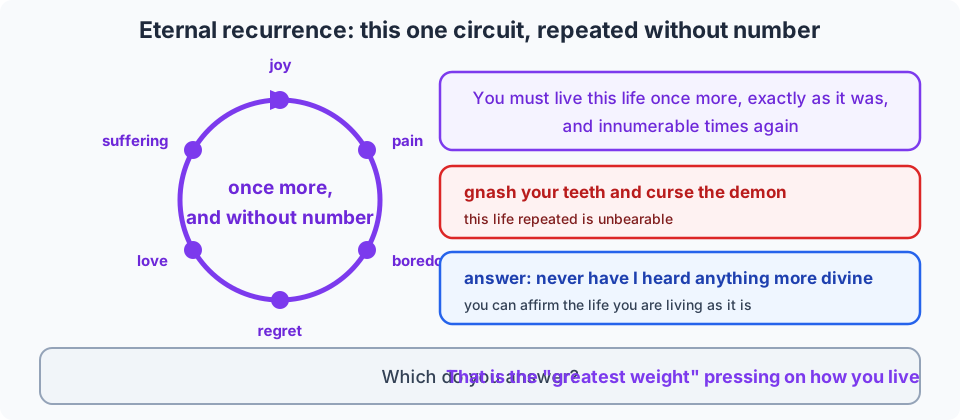
A section titled “The Greatest Weight”
The question first appears in The Gay Science, published in 1882, in a section headed “The Greatest Weight” (section 341).
The choice of word matters. This is offered not as a light consolation but as something that bears down on you.
At the end of the section Nietzsche asks: if this thought gained possession of you, the question “do you want this once more?” would lie upon every act as the heaviest weight.
There is no second attempt. The same thing happens next time. No cancelling, no making up for it, no sequel. Under those conditions, can you affirm today?
Two readings
There are broadly two ways of reading eternal recurrence.
As a claim about the structure of the universe. If time runs on infinitely and matter can occupy only finitely many states, the same configuration must recur. Nietzsche attempted arguments along this line in unpublished notes.
However, the claim has no support in physics. Neither the premise of a finite closed universe nor that of finitely many states fits current understanding. And Nietzsche did not put the argument forward in his published work.
As a touchstone for how to live. This is the mainstream reading. Whether it really recurs is beside the point. The device is for seeing how you answer when you ask yourself “supposing it did recur”.
Read this way, the discussion proceeds regardless of the cosmology.
What it measures
So what does the question measure, concretely?
One thing is your attitude to how you live now. Enduring the present because it will pay off later does not work under this setting, since the payoff too returns in the same order, forever. Affirmation that banks on future compensation is unavailable here.
The other is your attitude to the past. Accepting eternal recurrence means affirming the failures and humiliations exactly as they were.
Nietzsche took resentment toward the past seriously as something that weakens people. Against the unalterable fact of “it was,” the will is powerless. That powerlessness, he thought, breeds resentment and the desire for revenge.
Out of that comes the phrase amor fati, love of fate: to want to learn to see what is necessary as beautiful, rather than merely enduring or concealing it. On this reading, eternal recurrence is the device for checking whether you have reached that attitude.
Repetition, not universalisation
There is another famous touchstone in ethics: Kant’s formula asking “could the principle of your act become a rule for everybody?”
The two measure in entirely different directions.
| Touchstone | What it asks | Direction |
|---|---|---|
| Can it be universalised? | Could it be a rule anybody might follow? | outward, toward others |
| Can it bear repetition? | Is this a life you would live eternally? | inward, along time |
Kant’s question makes you review an act from another’s position. Nietzsche’s makes you review a life from the whole of time.
And no rule comes out of Nietzsche’s question. It does not tell you what to do. It only reflects your present state, which makes it less a moral principle than a diagnostic instrument.
Objections
Several criticisms have been directed at the idea.
Without memory it means nothing. If the repetition is exactly identical, the second time round you remember nothing of the first. From the inside it is indistinguishable from happening once, so being told it recurs changes nothing.
The reply is that whether it really recurs is not the point; the subject is your reaction when the question is put to you now. Adopt the touchstone reading and the criticism is dodged.
It is false as cosmology. As noted. Indefensible on that score, and it does not affect the core of the thought.
Demanding affirmation of the past is cruel. This is the weightiest criticism. Pressing somebody who has been seriously harmed to affirm that too is brutal.
Nietzsche’s words have often been read as a celebration of strength, and that reading has been used as an instrument for cornering people who are suffering. The question is one to put to yourself, not to thrust at somebody else.
Its spread into literature
The idea travelled far beyond philosophy (novels and films on repetition are past counting).
The best-known instance is the opening of a novel (a 1984 work by a writer from Central Europe). The author begins from eternal recurrence and remarks, in effect, that what happens only once might as well not have happened at all.
Because it does not repeat, a life is irrevocable and at the same time oddly weightless. If eternal recurrence is a weight, a life lived once is unbearably light. That inversion of Nietzsche’s question has been widely read as a piece of thinking in its own right.
Things people wonder about eternal recurrence
What if I answer “no” to how I live now?
Nietzsche supplies no answer, because the question is a diagnosis, not a prescription.
Something is gained from the answer regardless: you learn which parts you would not want repeated. Identifying the passages that cannot bear repetition is in practice more workable than evaluating a whole life vaguely.
Could I answer “yes” if my life were easy?
Not so simple. What Nietzsche had in mind was affirmation that includes the pain and the difficulty. A life spent avoiding suffering does not necessarily bear repetition.
What concerned him was not the quantity of pleasure but whether you have taken your life on as your own. An easy life lived to other people’s expectations may feel heavy when you are told to repeat it.
Is it the same as rebirth in Buddhism?
Similar in appearance, opposite in direction. In doctrines of rebirth, the cycle is to be broken; liberation is escape from it.
Nietzsche presents the repetition as something to be accepted, and wanted. Same circle in the picture, and the opposite demand: escape from it, or affirmation of it.
Related thought experiments
Articles on how a life is evaluated and what happiness is. Beside eternal recurrence, the differences in how they measure stand out.

Summary
This article covered “Eternal Recurrence.”
This life, identically, without number. Whether you can affirm how you live with no second attempt and no compensation is a question that teaches no moral rules. It reflects, without mercy, where you are standing now.
It is false as cosmology, and cruel if thrust at somebody else. As a question put quietly to yourself, it could hardly be better made. Nietzsche called it the greatest weight because he knew it was not something to lean on but something that bears down.
To return to the full list of thought experiments, follow the link below.
Thank you for reading. We hope to see you in the next article.

Also popular with readers
📚 Series: Famous Thought Experiments (47/60)