
Thank you for visiting this site. This article covers “The Invisible Gardener.”
Two explorers come upon a clearing deep in the jungle. Flowers grow there, and weeds among them.
One says: “Somebody must be tending this. There must be a gardener.” The other answers: “There is no gardener.”
So they set out to check. And every time they try, the gardener is granted a new property and recedes further from view.
The parable was built to ask what a claim is still asserting after it has been qualified repeatedly to slip past refutation.
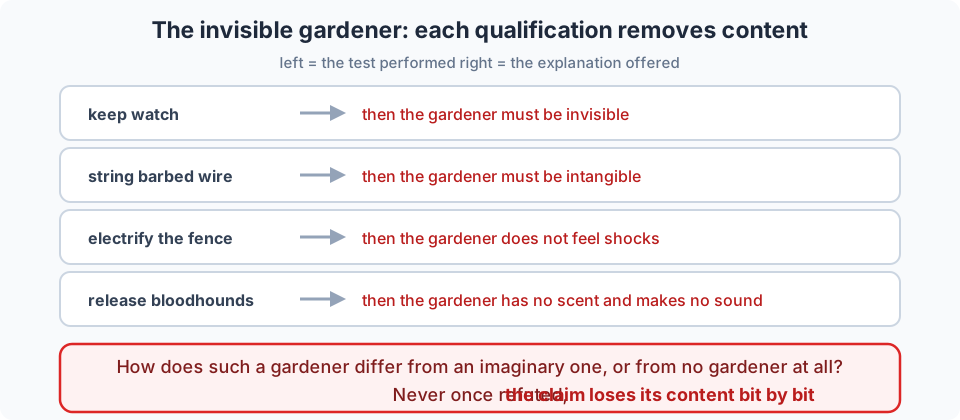
The tests fall one by one
Follow the checks in order.
Keeping watch. They take turns watching the clearing. Nobody appears. The believer says: “then the gardener is invisible.”
Barbed wire. An intruder would disturb the wire. Nothing moves. “Then the gardener is intangible.”
An electric current. A touch would produce a cry. Nothing is heard. “Then the gardener does not feel shocks.”
Bloodhounds. They would follow a scent. The dogs do not bark. “Then the gardener has no scent and makes no sound.”
The claim has become this: an invisible, intangible, shock-proof, scentless and silent gardener secretly tends this garden.
So the sceptic asks: how does your gardener differ from an imaginary gardener, or from no gardener at all?
Death by a thousand qualifications
The parable owes its fame to a paper Antony Flew published in 1950. It was based on a parable written a few years earlier by another philosopher, which Flew sharpened into a weapon of argument (the original was a gentler question).
His claim is clear. For a claim to assert anything, it must deny something.
If there is nothing you can point to and say “if this happened, my claim would be wrong,” the claim says nothing about the world. A claim compatible with every observation is merely a claim that permits every observation.
Flew put the result of endless qualifying memorably: death by a thousand qualifications.
The claim is not refuted at a stroke. Each time it survives by picking up another condition, it loses a little of its content. By the time anyone notices, it has become something that says nothing at all.
The question about talk of God
What Flew was really pressing was of course not gardeners but religious statements.
He put a concrete question to believers: what would have to happen for the claim that God is love to be wrong?
A child suffers and the claim is not withdrawn. A disaster occurs and it is not withdrawn. Instead an explanation is added, such as “a love beyond human measure.”
If so, the claim is compatible with any event. Flew’s question narrows to one point: “then what is it asserting?”
Two famous replies
Two philosophers answered the challenge head-on. Because of that exchange, the invisible gardener is not merely a parable of criticism but a standing site of argument.
Belief as a way of seeing the world
The first introduced the notion of a blik.
His example (a fairly extreme one): a student is convinced that the university dons are trying to kill him. Introduce him to the mildest don you like and his conviction does not budge, since that too is part of the plot.
The student’s belief certainly admits no refutation. And that does not make it meaningless, he argues, because we all live holding a number of assumptions that evidence does not move.
Driving, for instance, on the belief that the steering will not suddenly fail. Such ways of seeing the world do a different job from factual claims, and they shape behaviour. Religious statements, on this reply, are of that kind.
The position has a weakness: it does not answer well how a right blik is distinguished from a wrong one.
Believing on, while granting the evidence
The second replied from an entirely different angle, in what is called the parable of the partisan.
In an occupied country, a man in the resistance meets a stranger who tells him that he is the leader of the resistance and asks to be trusted whatever happens. The man trusts him.
Afterwards he sees this person many times. Sometimes helping their side, sometimes apparently collaborating with the enemy. His comrades call the man a traitor. Still he goes on believing “he has his reasons.”
The point lies in the difference from the gardener. The partisan grants that the contrary evidence is evidence. He does not look away. And on the strength of the trust first given, he suspends judgement.
Faith, on this account, is not ignoring refutation but maintaining trust while acknowledging the weight of contrary evidence. This position too has a limit: how much has to accumulate before trust should be withdrawn? Nobody has drawn that line.
What it carries outside the argument
The parable is not confined to religion.
I most often recall it where an explanation survives each objection by adding a condition: a plan with a fresh reason each time it fails, a forecast whose interpretation changes whenever it misses, a claim whose definition changes whenever it is criticised.
One question is effective there: “what would have to happen for this explanation to be wrong?”
If it can be answered, the explanation is asserting something. If it cannot, the explanation has probably stopped asserting anything. The parable of the gardener teaches the force of that question.
Things people wonder about the invisible gardener
Is it the same as Russell’s teapot?
Close, with a different emphasis. The teapot is about where the burden of proof lies — a procedural point that the claimant should produce evidence.
The invisible gardener asks about the conditions under which a claim has meaning: not whether there is evidence, but what is being claimed at all. And since replies to it are on record, it can be read as an exchange rather than a single blow.
What happened to Flew himself?
He was long known as a leading atheist and announced late in life that he had changed his position, having come to think that explaining the order of the universe and of life made positing some intelligence more reasonable.
The reversal was received with considerable surprise. It does not, however, undo the force of the invisible gardener. The edge of an argument and the position of its proposer are separate things. The same has happened to proposers of other thought experiments.
Is every unfalsifiable claim meaningless?
The position pressing that hard was influential in the first half of the twentieth century and is not held in that form now, because applying the criterion strictly makes ethics and mathematics meaningless too.
Today it is usual to hold that different kinds of claim have different conditions for meaning. Claims about facts, claims about values, and words expressing a way of seeing the world are handled on separate scales. The question the gardener raised was valuable partly for prompting that sorting.
Related thought experiments
Articles on what to do with claims that can be neither proved nor refuted, from other angles.
Summary
This article covered “The Invisible Gardener.”
Add a condition each time an objection comes and the claim, never once refuted, loses its content bit by bit. “Death by a thousand qualifications” is a fine name for the phenomenon.
And the parable comes with replies: belief as a way of seeing the world, and trust maintained while granting the evidence. Neither is a complete answer, and having criticism and response preserved together makes this an unusually well-finished thought experiment.
To return to the full list of thought experiments, follow the link below.
Thank you for reading. We hope to see you in the next article.

Also popular with readers
📚 Series: Famous Thought Experiments (46/60)