Thank you for visiting this site. This article covers the “Gettier Problem.”
What does it mean to “know” something? You believe it, it is actually correct, and you have proper grounds for believing it. With all that in place, surely you may say you know it.
Then in 1963 the American philosopher Edmund Gettier published a paper of just three pages that shook that assumption out at the roots. What he offered were examples that satisfy all three conditions and that nobody wants to call knowledge. Here is how a definition used since Plato’s day came apart in a few hundred words.
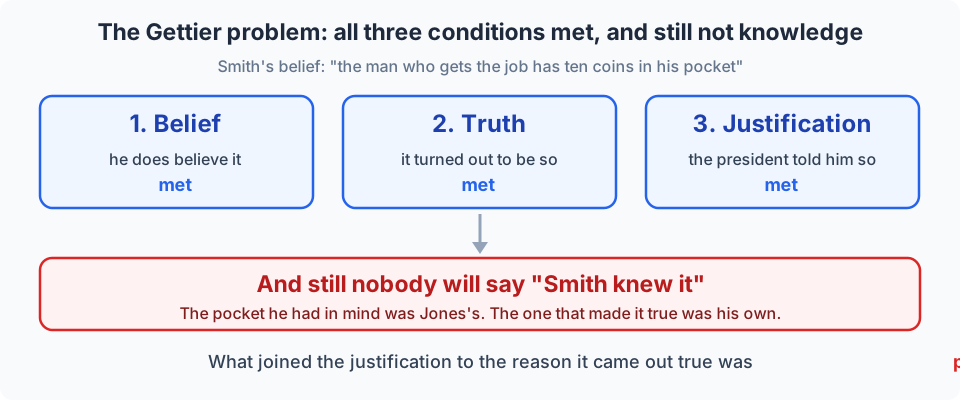
The definition of knowledge used for 2,000 years
Start with the definition Gettier took aim at.
Philosophy long held that knowledge is justified true belief — “JTB” for short. You can say someone knows something when three things hold.
- Belief: they believe it
- Truth: it is in fact the case
- Justification: they have grounds for believing it
Each is plausible once stated. You cannot know what you do not believe, and you cannot know something false. And guessing correctly by chance is not knowledge but “a fluke,” so grounds are needed too.
The prototype is already visible in Plato’s Theaetetus (where Plato himself suspends judgement). For more than two millennia since, epistemology textbooks have opened with those three conditions.
The two counterexamples Gettier produced
Gettier’s paper is bluntly titled “Is Justified True Belief Knowledge?” Rather than arguing against the definition in the abstract, he constructed two concrete cases satisfying all three conditions that cannot be called knowledge.
Ten coins in a pocket
Two men, Smith and Jones, have applied for the same position at the same company.
Smith has strong grounds. The company president himself told him “Jones is the one who will get the job,” and Smith has just counted the contents of Jones’s pocket and confirmed there are ten coins in it.
So Smith puts the two together and concludes: “the man who gets the job has ten coins in his pocket.”
But the man actually appointed was not Jones. It was Smith himself — and by coincidence Smith’s own pocket also happened to hold exactly ten coins.
So what became of Smith’s belief that “the man who gets the job has ten coins in his pocket”? He believed it, he had grounds, and it turned out true. All three conditions are perfectly met. And still nobody will say Smith knew it, because the man he had in mind was not himself and the pocket was not his.
The Ford and Barcelona
The second case is a little more devious.
Smith has ample grounds for thinking his colleague Jones owns a Ford. He has seen him driving one for years, and Jones came to work in a Ford today.
So Smith performs one logically valid inference, of the form “from A, infer A or B.” He believes the proposition “either Jones owns a Ford, or Brown is in Barcelona.” Smith knows nothing whatever about where Brown is; but since the whole is true if the first half is, the belief is justified.
In fact, though, Jones’s Ford was rented and he owns no car. And meanwhile, by sheer coincidence, Brown really did happen to be in Barcelona.
The upshot is that Smith’s belief is true. It is justified. And Smith understands nothing whatever about Barcelona.
What they share: getting it right by luck
What do the two cases have in common? This is, I think, the most interesting part of the Gettier problem.
In both cases Smith’s grounds are not wrong. The president’s testimony and the sighting of the Ford are ordinarily quite reliable. And yet the grounds and the reason the belief came out true connect at a completely unrelated place.
Put plainly, luck has inserted itself between the justification and the truth. Justification was added as a condition precisely to exclude flukes, and a fluke has slipped past the justification. This is the problem known as “epistemic luck,” and epistemology after Gettier has been wrestling with it ever since.
The long fight over a fourth condition
Against Gettier’s three pages, philosophers counter-attacked by adding a fourth condition to JTB. Here are the main attempts.
| Proposed repair | The condition added | Where it stumbles |
|---|---|---|
| No false lemmas | The inference passes through no false proposition | Useless against perceptual Gettier cases with no inference |
| Causal theory | The fact causes the belief | Handles knowledge of the future or of mathematics badly |
| Reliabilism | The process producing the belief yields truth with high probability | Where to draw “high probability” never settles |
| Counterfactual (tracking) | Had it been false, you would not have believed it | So strong that it denies ordinary knowledge too |
| Virtue epistemology | You got it right through your own competence | The line around “through competence” stays vague |
The first out was “no false lemmas.” In both cases Smith steps on a false proposition — “Jones will get the job,” “Jones owns a Ford” — so add a condition that inference passing through a falsehood is not knowledge.
That repair was breached quickly. The famous case is “the barn facade.” In a district full of film-set barn fronts, you happen to look at a genuine barn and think “there is a barn.” No inference, no false premise anywhere. And knowing everything around it was fake, you will not want to call that knowledge either.
Causal theories, reliabilism, counterfactual conditions and virtue epistemology followed, and each attracted new counterexamples. In 1994 an argument was published to the effect that any condition independent of truth can be defeated by the same trick — suggesting the very project of patching JTB may have a limit in principle.
Out of that impasse came the position of “giving up the idea of decomposing knowledge into simpler parts.” Take knowledge as basic, and explain belief and justification from it — the order reversed.
Questions this problem tends to raise
Has it actually been solved?
No. More than sixty years and countless proposed repairs later, none has been agreed on as definitive. If anything, the discussion has moved toward “perhaps writing necessary and sufficient conditions for knowledge is impossible.”
Why did three pages become this famous?
The gap between the paper’s brevity and the size of its target. Gettier established no new theory; he simply threw two comprehensible counterexamples at a definition nobody had doubted. That alone rewrote chapter one of the textbooks. Gettier himself published almost nothing afterwards, and his name survives in the history of philosophy on this one paper. (There is a story that colleagues had to talk a reluctant Gettier into publishing it.)
Is there any point thinking about it in everyday life?
Yes. When “I had grounds, and the result was right” both hold, we tend to conclude our judgement was sound. What Gettier’s examples show is that both can hold while the reason it came out right lies somewhere else entirely. In an investment decision or a work forecast, treating a correct outcome as proof that the reasoning was correct means being wrong next time you use the same method. Getting into the habit of asking whether you can also explain why it came out right helps you avoid the trap.
Related thought experiments
Thought experiments about the certainty of knowledge and perception, digging at the question of “is what I take myself to know really knowledge?” from other angles.
Summary
This article covered the “Gettier Problem.”
Believed, true, justified. That seemed to be enough for knowledge, and the count of coins in a pocket brought the definition down. That the paper undoing two thousand years of assumption ran to three pages is part of the pleasure.
Watching repair after repair proposed and broken shows just how much trouble the everyday word “know” has been quietly carrying. I read the problem less as a record of failure without an answer than as the practical question of “how do you tell a fluke from real understanding?”
To return to the full list of thought experiments, follow the link below.
Thank you for reading. We hope to see you in the next article.
Also popular with readers
📚 Series: Famous Thought Experiments (13/60)