Thank you for visiting this site. This article covers “Polchinski’s Paradox.”
Fire a billiard ball into a wormhole and it emerges in the past, where it strikes its own earlier self from the side, before that self has entered the hole. The deflected ball never enters, and therefore never travels back at all. It is a purely physical time-travel contradiction with no human will anywhere in it.
A contradiction built from billiard balls
The setup.
A wormhole has an entrance and an exit, and going in at the entrance brings you out at “the exit five seconds earlier.” Think of it as a device that goes back in time.
Fire a single billiard ball straight at it. The ball is swallowed by the entrance and flies out of the exit five seconds earlier.
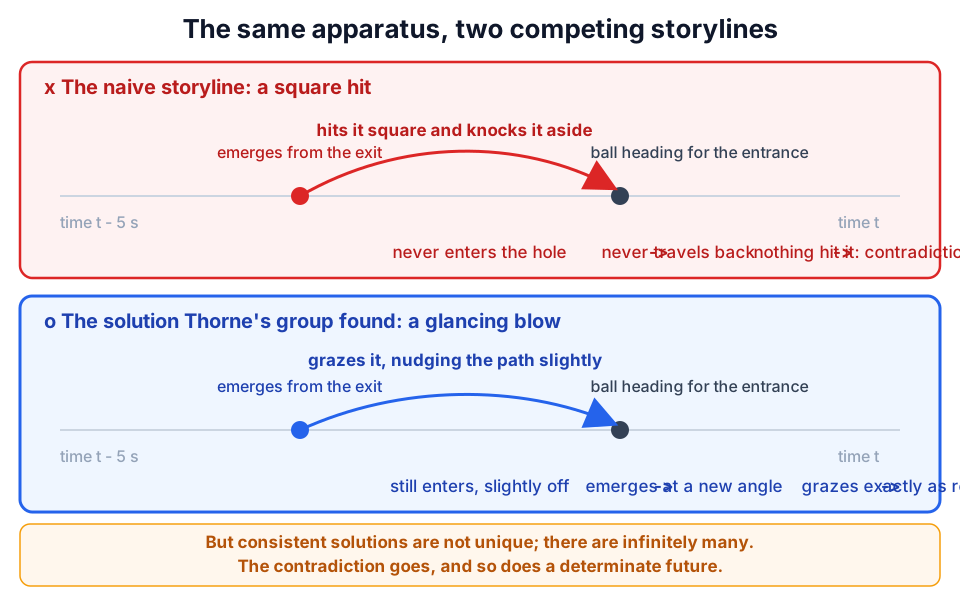
The problem is what happens next. Suppose the emerging ball’s trajectory has been arranged so that it strikes, from the side, the very self that is about to enter the entrance.
The struck ball changes course, misses the entrance and passes by. But if it never entered the entrance, it never travelled back to the past. And if it never travelled back, nothing deflected it, so it should have flown straight into the entrance.
Enter and be deflected; be deflected and fail to enter; fail to enter and never be deflected. Exactly the same loop as the grandfather paradox.
Why use a ball rather than a person
The grandfather paradox has always had a convenient escape route: “humans have free will, so you would simply find yourself unable to pull the trigger.”
You might change your mind, or your hand might shake. As long as a mind is involved, you can manufacture an exit.
What is excellent about Polchinski’s setup is that the only participant is a billiard ball. A ball has no will and no hesitation. Fix the angle and the speed, and Newtonian mechanics decides the rest.
So the contradiction arises not as a problem about minds but as a problem about physical law itself. It puts the question “does permitting time travel break physics?” squarely on the table.
The surprising answer Thorne’s group found
After the problem was raised around 1990, Kip Thorne at Caltech and his students Fernando Echeverria and Gunnar Klinkhammer worked it out properly.
What they investigated was whether “there really is no solution.” In 1991 they found their answer.
Consistent solutions do exist.
The trick goes like this. Consider the returning ball striking not squarely but “only a graze.” A lightly grazed ball is not knocked away entirely; its path shifts by a very small amount.
And travelling on that slightly shifted path it still enters the entrance, emerging in the past at a slightly different angle — one that produces exactly a graze against itself. “It was grazed, so its path shifted; the path shifted, so it could graze.” A completely closed storyline.
And then a different problem: too many solutions
If the story ended there it would be a happy resolution. The calculation showed something more awkward.
Self-consistent solutions were not one but infinitely many.
Fire the ball at the same angle and the same speed, and what happens afterwards is not determined uniquely. Countless storylines with different grazing angles all satisfy physical law.
By the standards of classical physics this is quite abnormal. Normally, fixing the initial conditions fixes the future. Permit time travel and you get a world where “the initial state alone does not determine what happens.”
The contradiction went away and determinism broke instead. You could say the problem merely changed shape, and I find that the most interesting part.
What it means for determinism to break
The result that there are infinitely many solutions is easy to skim past and has large consequences. Here is what is lost.
- Ordinary mechanics: fix the angle and speed and the subsequent trajectory is fixed completely
- With time travel permitted: the same angle and speed can produce countless different storylines
- No law selects which occurs: physical law permits every storyline equally
- Nor can probabilities be assigned: there is no way to say how likely each of infinitely many solutions is
Science can do the job of prediction because of the premise that the future is fixed uniquely by initial conditions. Break that and you can still calculate, but it is no longer prediction.
Quantum mechanics contains randomness too, and it is a different sort. There, “how likely each outcome is” is precisely determined, and it is fully predictable as a probability.
What is lost in Polchinski’s problem is a level deeper: not even the probabilities settle. The contradiction went, and what went with it was the vocabulary for talking about the future.
Support for the self-consistency principle
The result was received as support for Novikov’s self-consistency principle.
The principle claims that “events which would generate a contradiction have probability zero.” Stated baldly it sounds like a convenient dodge, and it carries weight to have actually constructed consistent solutions in a concrete case with billiard balls.
That said, it does not prove time travel is possible. At the prior stage of whether a wormhole reaching the past can be built at all, unsolved problems such as the required negative energy density remain in abundance.
What was established is one point: “even if time travel were possible, mechanics alone does not immediately rule it out.” Removing one item from the list of objections is not nothing.
What kind of physicist proposed it
Joseph Polchinski was one of the leading figures in string theory.
His greatest contribution was the 1995 discovery of D-branes, which greatly accelerated the field. Late in his life, in 2012, he also raised the firewall problem about what happens at a black hole horizon.
Lined up like that, Polchinski comes across as someone with a gift for extending existing reasoning straightforwardly and calmly producing the conclusion nobody wanted to see. The billiard ball has the same character: it translates the vague topic of time travel into a mechanics problem with no room to hide.
Can a time machine be built at all?
Polchinski’s problem assumes time travel is possible. Can the device itself be built?
The proposed mechanisms, and their obstacles
The equations of general relativity admit several solutions containing paths back to the past. Every one of them has a high barrier to realisation.
| Proposed mechanism | Published | What it needs | Main obstacle |
|---|---|---|---|
| Gödel’s rotating universe | 1949 | The whole universe to be rotating | Our universe is not rotating |
| Tipler’s cylinder | 1974 | An infinitely long, dense cylinder | Does not work at finite length |
| Morris-Thorne wormhole | 1988 | Negative energy density | The quantity required is vast and unsustainable |
| Gott’s cosmic strings | 1991 | Cosmic strings passing at near light speed | Shown to be impossible in an open universe |
What they share is that every one requires conditions ordinary matter can never supply. Negative energy density in particular has been confirmed to exist in minute quantities as a quantum effect, nowhere near the scale needed to hold a wormhole open.
The chronology protection conjecture
Against that background, Hawking put forward the chronology protection conjecture in 1992.
The claim is that “the laws of physics always prevent a path to the past from being created.” Just before time travel becomes possible, quantum fluctuations are amplified without limit and destroy the apparatus.
Hawking wrote, half-jokingly, that the purpose of the conjecture was “to make the universe safe for historians.” It is unproven, and settling it requires a completed theory of quantum gravity.
Related paradoxes of time travel
Related paradoxes where the premise of travelling to the past twists causation itself.




Summary
This article covered “Polchinski’s Paradox.”
To check whether a contradiction survives with human will removed, an object as thoroughly simple as a billiard ball was chosen. The answer was that consistent solutions exist, and there are too many of them for the future to be determined.
Push a problem far enough and something breaks in a different place from the one you expected. Physics thought experiments do this from time to time, and it is what draws me to them.
To return to the full list of paradoxes, follow the link below.
Thank you for reading. We hope to see you in the next article.

Also popular with readers
📚 Series: The World's Paradoxes (72/81)