Thank you for visiting this site. This article covers the “Predestination Paradox.”
You travel to the past to prevent a tragedy, and that very action turns out to be what caused it. Unlike the grandfather paradox, no contradiction arises; everything hangs together neatly. And still, nothing you do can change the ending. Precisely because it is consistent, there is no exit — which gives the problem a particular eeriness.
The man who went to prevent a fire
Start with a clear example.
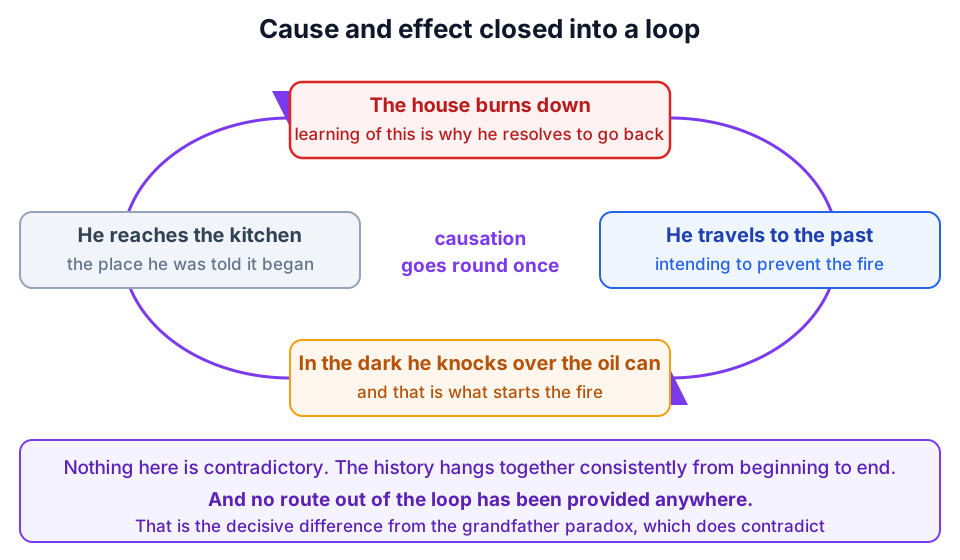
A man resolves to change the past in which his house burned down. He takes a time machine back to the day of the fire and hurries to the kitchen, which he had been told was where it started.
Rushing in the dark, he knocks over a can of oil that was standing there. The flame on the stove catches it, and the house goes up.
The action taken to prevent the fire was the cause of the fire. Had he not gone back, there would have been no fire. But had there been no fire, he would never have tried to go back.
There is no contradiction here. The history is consistent from beginning to end. And there is no way out of the loop either.
The absence of contradiction is the point
This paradox is often confused with the grandfather paradox, and its character is quite different.
In the grandfather paradox, going back and killing your grandfather means you are never born and so cannot go back, which means your grandfather does not die and you are born after all. A “genuine contradiction” — a logically impossible state.
In the predestination paradox, no contradiction arises anywhere. Everything that happened connects up; history runs once and closes cleanly.
The problem is elsewhere. If history is self-contained like this, then the person who went to the past never had any room to “change something by their own will.” He thought he was preventing the fire; in fact he had been assigned the role of starting it from the outset.
The name comes from theology
Predestination is originally a term from Christian theology, referring to the view that human salvation is determined in advance by God.
The question argued over there for centuries was “if everything is determined, does human choice mean anything?” A completely different context from time travel, and the question it arrives at is strikingly similar.
An older form still is Sophocles’ Oedipus Rex, often cited here. To avoid the oracle that he would “kill his father and marry his mother,” his parents abandoned the infant — as a result of which he grew up not knowing his real parents, and the oracle came true exactly.
The action taken to escape a prophecy is what fulfils it. The structure has been the material of stories for 2,500 years.
Novikov’s self-consistency principle
Modern physics has almost the same idea: the self-consistency principle, proposed in the 1980s by the Russian physicist Igor Novikov and colleagues.
The claim is extremely simple: “events that would generate a contradiction have probability zero in the first place.”
Go back and try to shoot your grandfather and the gun misfires, or your hand slips, or the man you aimed at turns out to be somebody else. You necessarily fail. Physical law does not permit contradictions, so only the possibilities in which you fail are realised.
It sounds strange, and adopting the principle makes time travel and physical law compatible. The price is that the actions of anyone who goes to the past were built into history from the beginning.
On that account, the predestination paradox is not a troubling case to be avoided but the only normal shape permitted in a world where time travel is possible.
Criticisms of the self-consistency principle
It looks like a convenient principle for making contradictions go away, and plenty of people find it unacceptable. The usual complaints:
- The mechanism driving the probability to zero is unexplained: it says contradictory events do not happen without saying what prevents them
- A world of convenient failures looks contrived: guns misfiring, hands slipping, mistaken identity. Coincidences piling up reliably reads as artificial
- It effectively denies free will: if you always fail whatever you attempt, it is hard to call it choosing
- There is no way to test it: short of time travel actually existing, correctness cannot be checked
The first has deep roots. “Contradictions do not occur” is not an observed regularity but a requirement imposed to make the theory work.
Defenders do not find that unnatural. Push on “why does it hold?” for conservation of energy and you find the same character, they say; nature simply comes with constraints of this kind.
Which side you take ends up being a question of how fundamental you take physical law to be.
A shape fiction returns to repeatedly
The structure suits storytelling extremely well and has been used many times in celebrated works.
In 12 Monkeys, the protagonist is sent to the past guided by his childhood memory of a shooting at an airport, and it emerges at the end that the memory was of watching his own death.
The final act of Harry Potter and the Prisoner of Azkaban is built on the same shape: the person who went back turns out to have been the one who performed the rescue he thought somebody else had performed.
I am rather fond of endings like these, because they do not stop at “something strange happened” but deliver the pleasure of the moment when you see it was all connected from the start. Being consistent, it leaves the enjoyment of checking the joins afterwards.
A settled future and free will
That said, the story is not purely comfortable.
Accept the self-consistency principle as it stands and the same suspicion arises about our own choices, not just a time traveller’s. Seen from the future, is my behaviour today not already fixed as part of history?
This is a problem you get anyway if physical law is deterministic, without invoking time travel. What the predestination paradox adds is the stronger setup: “even someone who knows the future cannot change it.”
If knowing changes nothing, is there any point in knowing? That leads on to the point that holding information and being able to move the situation are different things, and that is the part I find most interesting.
Telling the three time paradoxes apart
There are several puzzles about time travel, and their characters differ. They are easily confused, so let me sort them.
Which contradict, and which do not
| Paradox | Contradictory? | What the problem is | The way out |
|---|---|---|---|
| Grandfather | Yes | Your own existence is negated | Many-worlds, self-consistency |
| Bootstrap | No | Nothing anywhere is the origin of the object or information | Accept that no origin is required |
| Predestination | No | No room to change the ending ever existed | Revisit the definition of free will |
Only the grandfather paradox is a genuine logical contradiction; the other two hang together. The consistent ones are the harder to deal with, which is what makes this area interesting.
Predestination versus bootstrap
The two get discussed together, and what loops is different.
- Bootstrap: an object or piece of information is closed inside the loop, with no moment of creation
- Predestination: the origins of objects are unproblematic; what loops is only the causal relation between action and outcome
In the fire example, neither the oil can nor the kitchen has an origin problem. What is odd is only the direction of causation: he went back because he learned of the fire, and the fire happened because he went back.
Put differently, bootstrap asks “where did it come from?” and predestination asks “why can nothing be changed?”
Related paradoxes of time travel
Related paradoxes where the premise of travelling to the past twists causation itself.
Summary
This article covered the “Predestination Paradox.”
No contradiction, and no way around it either. Where the grandfather paradox ends at “impossible,” this one leaves its unease in the form of something that can happen and that nothing can alter.
The action taken to prevent it becomes the cause. The structure is not confined to time travel; it has something in common with everyday situations where worrying too much brings about the failure.
To return to the full list of paradoxes, follow the link below.
Thank you for reading. We hope to see you in the next article.
Also popular with readers
📚 Series: The World's Paradoxes (73/81)