
Thank you for visiting this site. This article covers “Galileo’s Falling Bodies.”
Release a heavy object and a light one together: which reaches the ground first? Ignoring air resistance, the modern answer is they land together.
For nearly two thousand years before that, people held that heavier objects fall faster. It fits intuition, and dropping paper against a stone certainly looks that way.
Galileo overturned the received view — and not with precision instruments. With nothing but the mental operation of tying two stones together, he showed that the accepted theory contradicts itself. When people talk about the power of thought experiments, this is the first case cited.
The common sense of twenty centuries
Aristotle held that a body falls at a speed proportional to its weight. Ten times heavier means ten times faster.
The view agrees well with ordinary observation. Drop a stone and a feather together and the stone lands first. Leaves drift down and iron balls plummet. As a fact anybody could verify, it was persuasive.
And Aristotle’s authority was immense. Throughout the Middle Ages his natural philosophy was treated as the very ground of learning, and his account of falling bodies was not considered a candidate for doubt.
A contradiction from a piece of string
In a late work Galileo examines the view through a dialogue between characters. His setup:
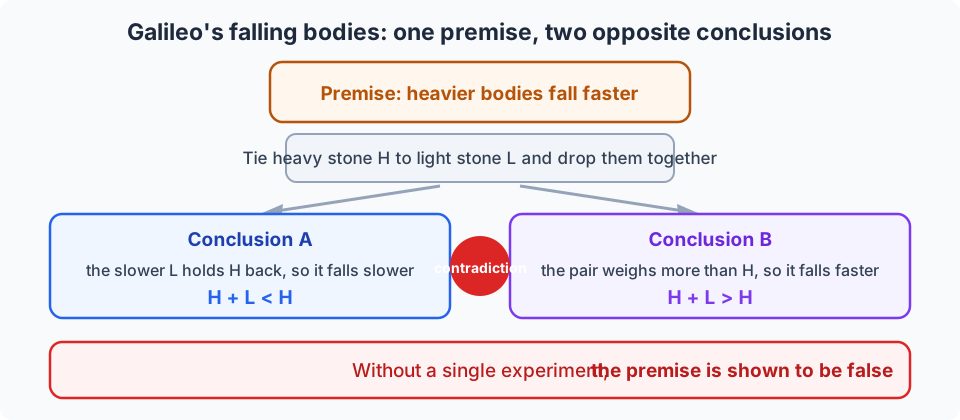
Take heavy stone H and light stone L, tie them together, and drop them.
Grant Aristotle’s rule and ask how the combined object falls. Two conclusions emerge.
Conclusion A. L alone falls slower than H. Tied together, the slower one drags on the faster. So the pair falls slower than H alone.
Conclusion B. But the pair weighs H plus L, more than H. By Aristotle’s rule, the pair falls faster than H alone.
The same premise yields opposite conclusions. The pair falls both slower and faster than H. That cannot be.
Since a contradiction has appeared, the starting point is wrong. What must be doubted is the premise that heavier bodies fall faster. If weight and rate of fall are unrelated, no contradiction arises.
Not a single experiment required
The elegance of the argument is that nothing was ever dropped.
All it took was accepting the existing theory and carefully drawing conclusions from it, then showing that the conclusions collide. This is exactly the hand of a mathematical reductio.
No new fact about nature was observed; a contradiction was found inside a theory already believed. Such arguments need no apparatus and come out the same for anybody who checks. This is where thought experiments are strongest.
There is a criticism that a hidden premise lurks: may two stones tied together be treated as one object? Are they one thing or two? The argument proceeds with that boundary left vague, and the objection is still discussed. It does not change the fact that later experiment confirmed the conclusion.
Was there really a Leaning Tower?
Galileo is famous for supposedly dropping balls of different weights from the Leaning Tower of Pisa.
Whether that happened is doubtful. The source is a biography written later by a pupil; Galileo’s own works say nothing about such a public demonstration.
That said, he did not slight experiment. What he actually performed and recorded was rolling balls down smooth inclined planes.
Free fall is too fast to time with the instruments of the day. So he used a ramp to stretch the fall out and confirmed that the distance rolled is proportional to the square of the time. That unglamorous experiment contributed far more to physics than any drop from a tower.
Remove the air and the feather keeps up
Our everyday sense that heavier means faster comes from air resistance.
Air resistance depends heavily on shape and surface area. A feather is light for its area, so it is strongly slowed. An iron ball meets the same resistance but has far more mass, so the effect is small. The difference is not weight itself but the interaction with the air.
You can confirm this by dropping a feather and a metal weight together in an evacuated tube. More famously, there was the demonstration on the moon in 1971 (the commander of Apollo 15 performed it on live television). On the airless moon he released a hammer and a falcon feather together, and they reached the surface at the same moment. Galileo’s conclusion, confirmed on another world more than three centuries after his death.
On to the equivalence principle
Why should bodies of different weight fall alike? There is a deeper answer.
Two kinds of “mass” are involved: the mass measuring resistance to being moved (inertial mass) and the mass measuring how strongly gravity pulls (gravitational mass). These are distinct concepts.
A heavy object is pulled harder and is also harder to move. Because the two masses are exactly equal, the stronger pull and the greater reluctance cancel, and the acceleration comes out the same.
Why are they equal? In Newtonian mechanics it was treated as a coincidence. Einstein saw deep significance in the coincidence, raised it into the principle that gravity and acceleration cannot be distinguished, and went on to general relativity.
So the two stones Galileo tied together led, three hundred years later, to a thought experiment about a lift. I find that one of the most satisfying continuous threads in the history of science.
Questions about Galileo’s falling bodies
Do they really land together without air?
Yes. In vacuum, bodies fall with the same acceleration regardless of mass or material. The equality is still tested repeatedly, and satellite experiments have confirmed it to extraordinary precision.
Any deviation would be a major discovery bearing on the foundations of general relativity, which is why tests keep pushing the precision higher.
How did Aristotle get it so wrong?
Not by neglecting observation. For bodies falling through air or water, his description is broadly right. What he was treating was motion in a resisting medium.
The problem was the absence of the idea of carving out an idealised case with no resistance. Modern physics began by considering ideal states with the extraneous stripped away. Galileo’s contribution lies less in the answer than in importing that way of thinking.
Where can this move be imitated?
The hand of accepting an opponent’s claim wholesale rather than denying it, and drawing out the consequences transfers directly.
Meeting an opposing view with counter-evidence tends to become a shouting match. Whereas carefully following what would happen if the claim were true brings out any internal contradiction on its own. That is exactly what Galileo did — which is why he needed no new observations at all.
Related thought experiments and paradoxes
Thought experiments about motion and gravity. Galileo’s conclusion becomes the starting point of the next era.


Summary
This article covered “Galileo’s Falling Bodies.”
Tie two stones together. That operation alone shows a theory believed for two thousand years colliding with itself. No apparatus, no cost, and anybody who follows it lands on the same conclusion — a model of what a thought experiment can be.
And the story has a fine sequel. The fact Galileo found, that bodies fall alike regardless of weight, was built three centuries later into a theory of spacetime itself. A piece of string tied in someone’s head reaching that far is a thoroughly pleasing thing.
To return to the full list of thought experiments, follow the link below.
Thank you for reading. We hope to see you in the next article.

Also popular with readers
📚 Series: Famous Thought Experiments (54/60)