
Thank you for visiting this site. This article covers “Chasing a Beam of Light.”
Ride a bicycle alongside a car and the car appears to move slowly. Match its speed exactly and it appears to stand still. Everybody has experienced this.
So what happens if you run at the speed of light? Would light appear to stand still?
Einstein later wrote that he had this daydream in his teens. And the fact that nobody could answer the naive question ended up rewriting the foundations of physics a decade later.
A daydream at sixteen
In an autobiographical piece written late in life (at seventy), Einstein described the following daydream from around the age of sixteen.
If I pursue a beam of light with the velocity c, I should observe such a beam of light as an electromagnetic field at rest though spatially oscillating. There seems to be no such thing, however, neither on the basis of experience nor according to Maxwell’s equations.
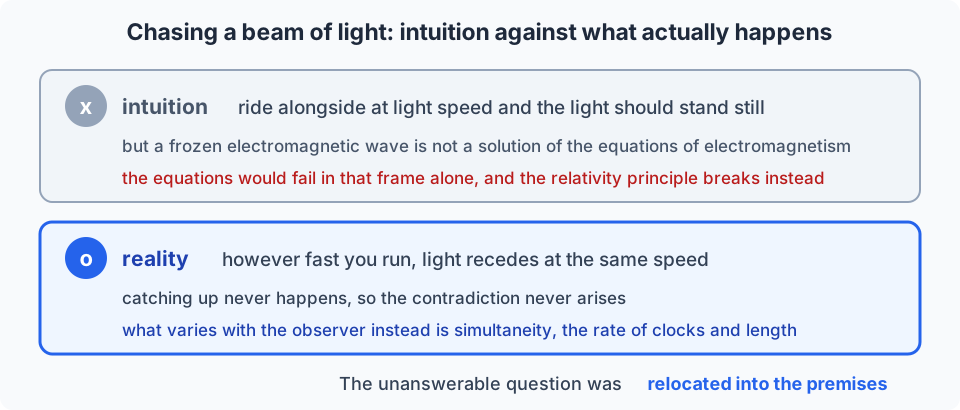
In other words: run exactly alongside a beam and the light stands still relative to you. In front of you would be an electromagnetic field frozen in the shape of a wave, going nowhere.
Nobody has ever reported seeing such a thing, and the equations of electromagnetism permit no such solution. What intuition delivers and what the theory allows are in conflict.
The recollection was written more than fifty years afterwards, so historians of science debate how clearly he thought it through at sixteen. That the contradiction troubled him for a long time is well attested across several sources.
Caught between two principles
Why this becomes serious deserves a closer look. Physics then rested on two pillars, neither of which could be given up.
First, the equations of electromagnetism. Assembled by Maxwell in the nineteenth century, they describe electric and magnetic behaviour with remarkable accuracy. And they imply that electromagnetic waves always travel at a fixed speed. Calculate that speed and it matched the measured speed of light exactly. Light is an electromagnetic wave.
Crucially, the equations have no solution corresponding to a stationary electromagnetic wave. A changing electric field produces a magnetic field, whose change produces an electric field again. That handoff is what carries the wave forward. Stop it and an electromagnetic wave stops being one.
Second, the principle of relativity. An old principle going back to Galileo: the laws of physics take the same form in every inertial frame. In the cabin of a ship moving at constant speed you cannot tell whether you are moving without looking outside.
Trying to hold both creates trouble. If catching up with light showed you stationary light, then the equations of electromagnetism would not hold in that person’s frame. Frames where the equations hold and frames where they do not would exist, and the principle of relativity breaks.
The ether as an escape
The answer physics had ready was a hypothetical medium, the ether.
As sound travels through air, light must have a medium. That medium fills the universe, and the speed of light means its speed relative to the ether.
That answers the boy’s question. Run at light speed relative to the ether and light would indeed stand still — a special state in which the equations need not take their usual form.
The escape had a price. If the ether exists, the Earth, orbiting at 30 kilometres a second, must experience an ether wind. Light travelling upwind and downwind should take slightly different times on a round trip.
A precise experiment in 1887 set out to detect the difference (the famous Michelson–Morley experiment). The result was nothing at all. The apparatus was sensitive enough, and the difference was zero.
The answer, ten years later
In 1905, a patent office clerk published a paper that disposed of the problem at the root. His approach was not to invent additional machinery.
Make “you cannot catch up with light” a starting premise rather than a mystery to be explained. That was the move. The paper begins by laying down two principles.
- The principle of relativity: the laws of physics take the same form in every inertial frame
- The constancy of the speed of light: in vacuum, light has the same speed in every inertial frame, whether the source moves or the observer does
The second is bizarre. Throw a ball at 50 km/h from a car doing 100 and the ground sees 150. But light, measured while running at any speed you like, recedes at the same speed.
Accept that and the boy’s question disappears. Chase light and it always outruns you at the same speed. The state of running alongside does not exist.
The price: time and length stretch and shrink
It is not free. If light’s speed is the same from every standpoint, things previously taken as absolute must give way to keep the books balanced.
| What broke | What happens |
|---|---|
| Simultaneity | Events simultaneous for one observer are not for another |
| Rate of time | A fast-moving clock runs slow as seen by an observer at rest |
| Length | A fast-moving object measures shorter along its direction of travel |
| Adding velocities | Velocities no longer add simply, and the result never exceeds light speed |
Since speed is distance divided by time, fixing the speed means distance and time have to move for the arithmetic to work. The theory makes the speed of light absolute at the cost of making time and space relative.
A word on adding velocities. Everyday intuition adds them straight. The correct composition law adds the two speeds and then divides by a factor that grows as light speed is approached. Thanks to that, adding two near-light speeds never gets you past light speed. At everyday speeds the divisor is essentially 1, which is why simple addition never troubles us.
Questions about chasing light
What does it feel like as you approach light speed?
Nothing feels different at all. That is exactly what the principle of relativity says. Moving at constant speed, your clock runs normally and your body has its normal length.
The stretching and shrinking appear only when two parties in relative motion observe each other. And the relation is symmetric. If their clock runs slow from my viewpoint, mine runs slow from theirs. Asking which one is really slow has no meaning.
Is exceeding light speed truly impossible?
Within present theory, a massive object cannot be accelerated to light speed. The faster it goes, the more energy each increment requires, and reaching light speed would take infinite energy.
There are phenomena not describable simply as “speed,” such as the expansion of space itself and the correlations of quantum mechanics. In each case no information travels faster than light, so far as is understood.
Has it been confirmed experimentally?
It has. Fast-moving particles are routinely observed to survive longer than they do at rest, and the drift in satellite clocks must be corrected using the theory or position-fixing does not work.
That, I think, is the most delightful part of this thought experiment. Reasoning that started as a boy’s daydream is now a precondition for the map on your phone working correctly. Few chains of pure thought bite into daily life this concretely.
Related thought experiments and paradoxes
Thought experiments about relativity and the strange consequences that follow. Read together, you can see how the treatment of time and space changed.


Summary
This article covered “Chasing a Beam of Light.”
A childlike question — “if I caught up with light, would it stand still?” — exposed a collision between the two pillars of electromagnetism and relativity and finally forced the ether, the common sense of the day, to be abandoned. That it starts from a question anybody could think of, rather than difficult mathematics, is the charm of this thought experiment.
The resolution is equally elegant. Stop trying to explain why you cannot catch up and reposition “you cannot catch up” as a premise. When you hit an unanswerable question, doubting the framing of the question is a stance that travels well beyond physics.
To return to the full list of thought experiments, follow the link below.
Thank you for reading. We hope to see you in the next article.

Also popular with readers
📚 Series: Famous Thought Experiments (53/60)