
Thank you for visiting this site. This article covers “Newton’s Bucket.”
You have seen stirred coffee dip in the middle and ride up at the rim. An ordinary sight.
Follow that ordinary phenomenon and you run into an awkward question: rotation relative to what?
In 1687 Newton produced the bucket experiment to answer it, and concluded that there exists an absolute space independent of any body. The claim has been argued over for more than three centuries.
Hang a bucket and twist
The apparatus is simple. Hang a bucket of water from the ceiling on a long cord, twist the cord many times, and let go.
The state passes through the following stages.
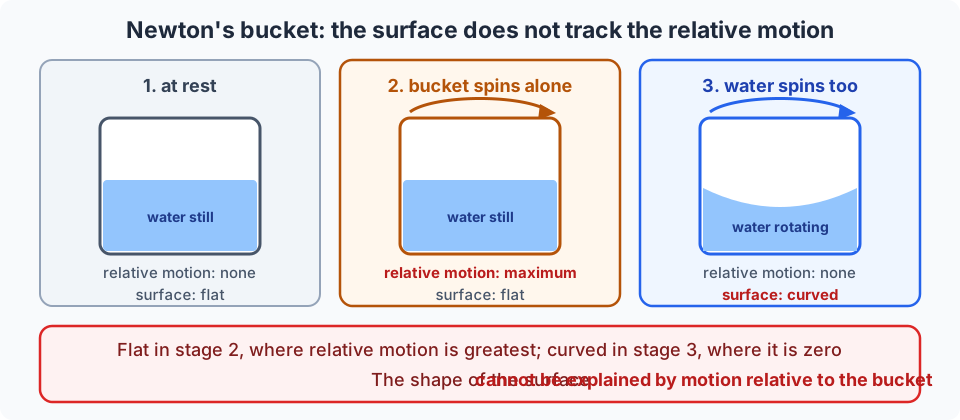
Stage one. Just after release the bucket has not begun to turn, and neither has the water. The surface is flat.
Stage two. The cord unwinds and the bucket starts turning. The water does not follow at once. Friction with the wall drags it slowly, and for a while it stays nearly still. At this moment bucket and water are sliding past each other most violently, and the surface is still flat.
Stage three. Eventually the water turns at the same rate as the bucket. There is no longer any relative motion between them. And it is precisely now that the surface is clearly curved.
Relative motion cannot explain it
Sort out what the observation shows.
| Stage | Relative motion of bucket and water | Shape of surface |
|---|---|---|
| One | none | flat |
| Two | maximum | flat |
| Three | none | curved |
Whether the surface curves has no correspondence at all with the relative motion. Flat when the relative motion is greatest, curved when it is zero.
Furthermore, stop the bucket suddenly by hand and the water keeps turning for a while, its surface still curved.
So what curves the surface is not motion relative to the bucket. Relative to what, then?
Newton’s answer
Newton’s conclusion was clear: the water rotates relative to absolute space, and that rotation curves the surface.
On his view, space is like a container for bodies. It exists in its own right whether or not anything is in it, unmoving and uniform without limit. Motion is change of position relative to that container.
The bucket was offered as evidence for the existence of absolute space. There is a phenomenon relative motion cannot explain; therefore motion relative to something non-relative must be real.
Newton gave a second example to the same effect (following in the same scholium of the Principia). Imagine two globes joined by a cord, alone in an otherwise empty universe. There is nothing to compare them with. And still, if there is tension in the cord, we can judge that the globes are rotating.
Space is nothing but relations
Leibniz opposed the claim head-on.
For him space is nothing but the order produced by the relative positions of bodies. No bodies, no space. He rejected the very idea of a container existing independently of its contents.
One reason is that absolute space cannot be observed. Shift the whole universe sideways and nobody could tell. A theory that supplies two indistinguishable states is carrying a superfluous assumption.
The disagreement survives as a correspondence. Leibniz, however, never gave a satisfying account of the bucket itself. Being unable to answer why the surface curves was his weak point in the dispute.
Perhaps the distant stars are the cause
Ernst Mach moved things along in the nineteenth century.
His idea is original. Perhaps the water is rotating not relative to absolute space but relative to all the matter in the universe. It rotates relative to the frame set by the distant stars and galaxies as a whole, and so its surface curves.
Mach put a memorable demand to Newton’s experiment: nobody knows what would happen if you kept thickening the walls of the bucket until they were kilometres thick. Newton observed a thin-walled bucket, and concluding something about the whole universe from it goes too far.
The idea, called Mach’s principle, strongly influenced the young Einstein (who coined the name). That inertia is not an intrinsic property of a body but is fixed by its relation to everything else in the universe was among the motivations for building general relativity.
The modern answer
So what does physics say now?
In general relativity the container called absolute space is gone. In its place is the structure of spacetime. The path a force-free body follows is determined by the shape of spacetime, and rotation is judged against that structure.
And the structure of spacetime is affected by the distribution of matter. The theory predicts that a rotating massive body drags the surrounding spacetime, an effect confirmed by precise satellite observation. In that respect Mach’s idea has been partly realised.
Not entirely, though. Even in a universe containing no matter at all, the equations have solutions in which rotation is defined. If Mach’s principle were fully correct, rotation should be meaningless where there is no matter to compare against. Present theory takes neither Newton’s nor Mach’s side completely.
That lack of resolution is what I find most interesting here. A question begun with one bucket still connects, three centuries on, to open parts of cosmology.
Questions about Newton’s bucket
Why does the surface curve?
Each part of the rotating water tends to move in a straight line. Without a force pulling it inward it cannot keep going round a circle.
That force is supplied by the pressure difference created when the water piles up at the outside. With the rim deeper, the inward push increases and the rotation is sustained. At equilibrium the surface takes the shape of a parabola.
This explanation holds regardless of what the rotation is measured against. The problem lies only in the criterion for saying “it is rotating.”
Does this relate to the Earth’s rotation?
The same structure. That the Earth spins can be determined without looking outside — from the slow turning of a pendulum’s plane of swing, and from the curvature of large-scale air flows.
Knowing you are rotating without seeing a single star is exactly the property Newton pointed at. Whether you are moving at constant velocity cannot be told from inside; whether you are rotating can. That asymmetry is the starting point of the argument about absolute space.
Has the problem been solved?
It has not. General relativity greatly changed the conception of space without fully realising Mach’s principle.
How to understand the origin of inertia remains open. An experiment you could run at home, hanging a bucket and spinning it, still touches the foundations of cosmology. Few questions have that kind of stamina.
Related thought experiments and paradoxes
Articles on how space and motion are conceived. You can see where the question that began with Newton’s bucket went.


Summary
This article covered “Newton’s Bucket.”
Whether the surface curves fails entirely to track the relative motion of bucket and water. From that simple observation, the question of whether space itself is real rises up. The apparatus is a cord, a bucket and some water, and the destination is the structure of the universe.
Newton answered absolute space, Leibniz relations alone, Mach the matter of the whole universe. And modern theory stands slightly apart from all three. Three hundred years, and still unsettled. Something to recall every time you stir your coffee.
To return to the full list of thought experiments, follow the link below.
Thank you for reading. We hope to see you in the next article.

Also popular with readers
📚 Series: Famous Thought Experiments (55/60)