Thank you for visiting this site. This article covers “Quantum Suicide.”
A warning first: this is not a thought experiment anybody should carry out. And as explained below, carrying it out establishes nothing. By its structure it cannot convince a single other person.
It has nonetheless been discussed seriously among physicists, because it presses on the most unpleasant part of the dispute over how to interpret quantum mechanics. Take the many-worlds interpretation at face value and it becomes unclear how to handle your own death. The setup extracts that difficulty.
The premise: the many-worlds interpretation
Start with the view the argument presupposes.
In quantum mechanics the state of a system is not determined until it is observed. On observation it settles to one value, and what that settling physically is remains without consensus. Filling that gap is the interpretation problem.
The many-worlds interpretation is one candidate. On it there is no collapse on observation. Instead every possibility is realised and the world itself branches. The me who saw spin up and the me who saw spin down both exist.
It sounds extravagant, and it has a merit: no mysterious collapse process need be added to the theory. You read the equations straight, with no extra machinery. A fair number of physicists value that economy.
The skeleton of the argument
From here quantum suicide is built. Several people arrived at it independently in the 1980s, and the version organised by the physicist Max Tegmark in the 1990s is the best known (independent invention is common in this area).
The apparatus imagined:
- A quantum measurement (say a particle’s spin) drives a mechanism
- One outcome makes it fire lethally; the other makes it do nothing
- The experimenter sits in front of it and repeats the measurement
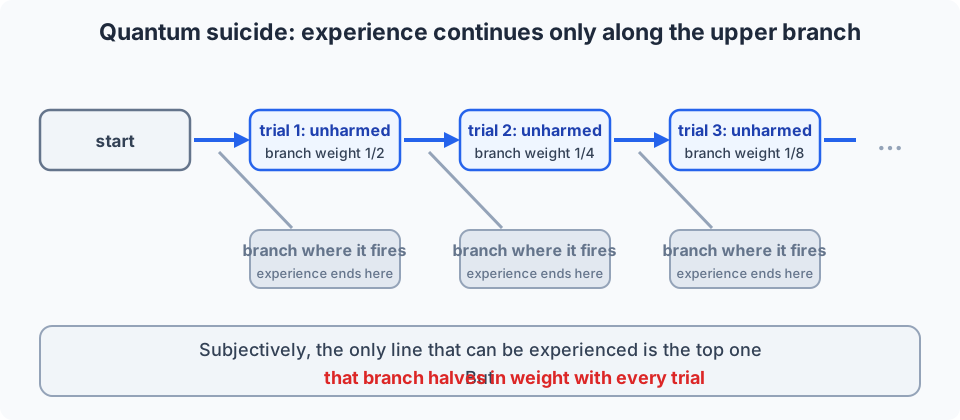
If many-worlds is right, each measurement splits the world in two. In one branch the experimenter dies; in the other they survive.
The core of the argument is what comes next. In the branch where they die, their experience ends there. Experience continues only in the surviving branch.
So the series the experimenter subjectively undergoes is an unbroken run of “it didn’t fire this time either.” After ten trials, after a hundred, what they experience is the branch where they were unharmed. From their own viewpoint they appear to survive every repetition without fail.
Generalised, this becomes quantum immortality: in any dangerous situation, so long as a branch where your consciousness continues exists with nonzero probability, you subjectively follow that branch. So you can never experience your own death.
Tegmark’s conditions
Tegmark pointed out that the argument requires stringent conditions.
| Condition | Content |
|---|---|
| Genuinely quantum randomness | A classical random trigger produces no branching, so the argument fails |
| Instantaneous death | An intermediate state of fading consciousness puts that branch into experience |
| Reliably lethal | Branches in which you half-survive become the dominant experience |
The third matters most. Real dangers are rarely a binary of death or safety. Branches in which you survive badly injured are abundant. If you subjectively follow the surviving branch, where you arrive is not “the unharmed me” but “the barely alive me.”
Tegmark, having presented the argument, stated plainly that he had no intention of performing it.
The decisive objections
The argument faces several strong replies.
The weight of the branch decreases. The most fundamental point. In many-worlds, branches do not all carry equal weight. Each has a measure, and probabilities correspond to those weights.
The weight of the surviving branch halves at every trial: one in a million after twenty, one in a trillion after forty. A branch existing and a branch having meaningful weight are different things. If mere existence were reassuring, a branch where you keep winning the lottery also exists, so nobody need work.
From outside, you simply die. To everybody but the experimenter, this person is near-certain to die within a few trials. Only observers in the surviving branch have the special experience, so nobody outside can share the result.
Consequently, performing it is pointless. Even after surviving a hundred trials, that is no reason to believe many-worlds; other interpretations explain it as good luck. Not even the experimenter can offer their experience as evidence to anyone else. As a means of testing a theory it is entirely non-functional.
The identity of consciousness is vague. May both people after a split be called “me”? That question is the problem of personal identity itself. What looks like quantum mechanics rests on an unresolved problem in philosophy.
What it does teach
Why is it still discussed given all that?
Because, I think, it brings out that differences of interpretation cannot in principle be settled by observation. Many-worlds and its rivals agree on every experimental prediction, so ordinary experiments cannot separate them.
Quantum suicide was an attempt to break through that wall: stake the observer’s own existence, and perhaps the difference will show up in subjective experience.
The attempt failed. The experience cannot be communicated, so it does not fit the procedures of science. The manner of the failure clarified the character of the interpretation problem. Put the observer into the accounts and you step outside what science can handle.
Questions about quantum suicide
Are we already inside quantum immortality?
Hardly any physicist holds that, for the reason of measure given above. There is no ground for treating a branch of vanishing weight as the road you will certainly take.
There is also ageing. As Tegmark noted, the argument applies only to instant death. Dying of old age is a continuous process, so branches with gradually fading consciousness dominate and the premise collapses.
Is many-worlds the mainstream view?
Not mainstream, but one of the leading candidates. Surveys of physicists find a steady level of support, split against other interpretations.
The important thing is that every interpretation yields exactly the same experimental predictions. So the choice gets argued on economy and taste in explanation. Quantum suicide was an attempt to break that deadlock that failed.
Is there a usable lesson?
That “the possibility exists” and “you may count on it” are different. The weakness of the argument was looking only at the existence of a possibility and not at its weight.
The same mistake happens daily. Think of one route by which things work out and it starts to feel likely — a bias that shows up constantly in estimating plans. Ask not whether something exists but how much weight it carries. Quantum suicide teaches that distinction in its most extreme form.
Related thought experiments and paradoxes
Articles on the relation between observers and the world. Beside quantum suicide, the difficulty of putting yourself into the accounts becomes visible.

Summary
This article covered “Quantum Suicide.”
Take many-worlds at face value and you subjectively follow a branch in which you always survive. The eerie conclusion grew out of an attempt to settle a question of interpretation by observation.
Follow the argument and you run into the reply that a branch existing and a branch having meaningful weight are different things. And above all, since the experience cannot be shown to anybody, it never worked as a test to begin with.
As stated at the outset, this is not something to carry out, and carrying it out would establish nothing. As an example of a question to be handled strictly inside the head, few are clearer.
To return to the full list of thought experiments, follow the link below.
Thank you for reading. We hope to see you in the next article.
Also popular with readers
📚 Series: Famous Thought Experiments (56/60)