Thank you for visiting this site. This article covers the “Friendship Paradox.”
Think of your friends and somehow they all seem better connected than you. That is not modesty or distorted self-assessment; it is a phenomenon that holds mathematically in almost every network of human relationships. On average, your friends have more friends than you do — and this holds for nearly everybody simultaneously.
Checking it on a tiny friendship network
Words alone make it hard to believe, so let me count in a world of four people.
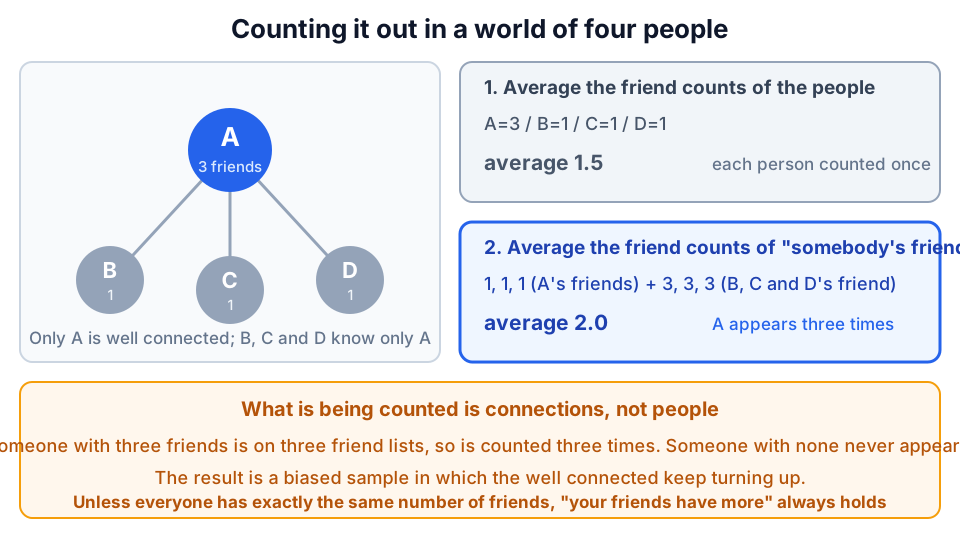
There are A, B, C and D, connected like this. A is friends with all three others. B and C are friends only with A. D is friends only with A.
Individual friend counts: A has 3, and B, C and D have 1 each. The overall average is (3+1+1+1)/4 = 1.5.
Now count “how many friends do your friends have.” A’s friends are B, C and D, each with one friend. B’s only friend is A, who has three. Same for C and D.
Line up the friend counts of every “somebody’s friend” and you get 1, 1, 1, 3, 3, 3. The average is 2.
The people average 1.5; the friends average 2. The friends really do have more.
Well-connected people get counted repeatedly
The trick is in the counting.
When we count “friends of friends,” we are not counting people one at a time, equally. We count each person as many times as they appear as somebody’s friend.
Someone with three friends appears on three friend lists, so is counted three times. Someone with one friend appears once. Someone with none never appears at all.
Look at people through friend lists and you build a biased sample in which the well connected appear repeatedly and the isolated barely appear.
This is sampling bias, and what makes it awkward is that it assembles itself unintentionally. You “selected a connection” and think you “selected a person”; that mismatch is the cause.
There are essentially no exceptions
How strong is the property? Very.
Mathematically, the average friend count of friends can never fall below the average for the people themselves. Equality holds only when everybody has exactly the same number of friends; otherwise the friends always come out higher.
In real human networks nobody has an identical social range, so it holds effectively everywhere.
The property was pointed out in a 1991 paper by the American sociologist Scott Feld. The title was “Why Your Friends Have More Friends Than You Do,” which states the content in a line.
The same logic applies beyond friendship. Co-authors tend to be more cited than you; the people you follow on social media tend to have more followers than you. Everyone you see at the gym seeming to go more often than you is the same bias: frequent attenders are more likely to be encountered.
The size of the gap is set by the spread
How wide the gap gets can be expressed simply.
More spread, bigger gap
With mean friend count m and variance v, the mean friend count of “somebody’s friend” is:
m + v / m
In other words, the people’s average m plus the variance divided by the mean.
In the four-person example, the mean was 1.5 and the variance 0.75. 0.75/1.5 = 0.5, so 1.5 + 0.5 = 2.0, matching what we counted.
Two things follow. First, the gap vanishes only when the variance is zero, that is, when everybody has the same number of friends. Second, the more unequal the social ranges, the more dramatically the gap opens.
On social media, where a minority hold connections of a different order of magnitude, the variance is extreme. Gaps of several to several dozen times are unremarkable.
The same structure is everywhere
The mechanism of a switched counting unit surfaces all over.
| Phenomenon | Counting method A | Counting method B | Where B comes out larger |
|---|---|---|---|
| Friendship paradox | Per person | Per connection | Friends’ friend counts |
| Class size | Per class | Per student | Perceived class size |
| Bus waiting time | Per interval | Per arrival time | Actual wait |
| Road congestion | Per time slot | Per driver | Congestion experienced |
| Citations | Per paper | Per citation | Co-authors’ citation counts |
In all of them, “what was counted as one” got swapped midway. Rather than memorising them individually, it is faster to develop the habit of suspecting that one point.
Part of why social media feels hard
The phenomenon connects well with how modern life feels.
What flows down a social feed comes from people who post a lot and are widely connected. The everyday life of someone who rarely posts never enters your field of view.
The impression that “everyone is thriving” forms, and it is not a picture of average people but a sample heavily skewed toward the visible.
The feeling of being the only one left behind has structural causes mixed in with the psychological ones. Since learning this, I try not to treat the impression from a feed as representative of reality. Knowing it comes out that way as a property of the numbers makes it a bit easier to take calmly.
It extends beyond friend counts
This is not only about numbers of friends.
By the generalised friendship paradox, pointed out by Eom and Jo in 2014, any attribute correlated with connectedness shows the same bias.
- Researchers’ citation counts: co-authors tend to be more cited than you
- Engagement on social media: the people you follow tend to get more responses
- Activity levels: acquaintances look more active than you
Same logic. Visible people enter more fields of view; invisible people are never counted. As long as being highly connected is itself linked to a high value on the attribute, the bias propagates.
So the sense that “the people around me are better” contains a substantial part explained purely by sampling bias rather than by any difference in ability.
To check where you stand, you have to doubt the method of comparing yourself to the people around you. The people around you are not a random sample; they are a set skewed toward the visible.
Honestly, learning the generalisation made me realise again that choosing what to compare against decides the conclusion. Half the answer is settled the moment you pick the comparison.
A surprising use in epidemic control
Interestingly, this bias is usable as a tool rather than only a weakness.
To stop an infection spreading, the most effective move is to protect the people with many contacts first. Identifying who those people are in advance would require mapping the connections of an entire society, which is impossible in practice.
The friendship paradox provides a way in. Pick people at random and ask each to name one friend. Then target the named. That alone makes the highly connected naturally more likely to be selected.
Without knowing anything about the network structure, you reach the people at the centre efficiently. The technique has been studied since around 2003 and has been used for early detection of outbreaks.
Related paradoxes that defy probabilistic intuition
Related paradoxes where the arithmetic is correct and the answer refuses to sit with intuition.

Summary
This article covered the “Friendship Paradox.”
Feeling surrounded by better-connected people comes from sampling connections rather than people. The cause was never on your side; it was in the counting.
How was this information gathered? Checking that once changes the meaning of the landscape in front of you. The subject packs the frightening and the fascinating sides of statistics into the same place.
To return to the full list of paradoxes, follow the link below.
Thank you for reading. We hope to see you in the next article.

Also popular with readers
📚 Series: The World's Paradoxes (31/81)