Thank you for visiting this site. This article covers the “Two Envelopes Paradox.”
Two envelopes sit in front of you, one containing twice as much money as the other. Pick one, compute the expected value, and the answer says swapping gains you 25%. Do the same calculation after swapping and it again says to swap, and it never ends. Nothing in the arithmetic looks wrong, and only the conclusion is plainly absurd.
Two envelopes, and an invitation to swap
The rules are very simple.
There are two envelopes, both containing money. One holds exactly twice as much as the other. You do not know which is which.
Pick one up. You have not looked inside. You are then told “you may swap for the other one if you like.”
Intuitively it should make no difference. You chose between two envelopes on equal terms, so there is nothing to gain or lose.
The calculation that says to swap
Calculate it like this, though, and you get a completely different answer.
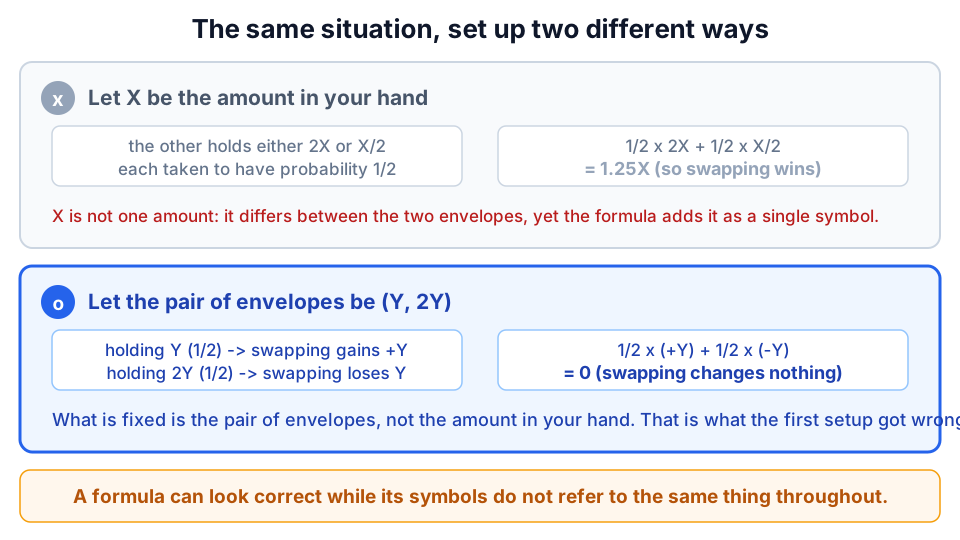
Let the amount in the envelope you hold be X. The other envelope holds either twice X or half X, and each looks equally likely.
Take the expected value of swapping.
Expected value after swapping = 1/2 × 2X + 1/2 × X/2 = X + X/4 = 1.25X
You hold X, so swapping raises the expected value by 25%. Better to swap, then.
Which lets you swap forever
Here is the problem.
You swapped and now hold a new envelope. You still have not looked inside. So run the same calculation again.
Let the amount in hand be X; the other is 2X or X/2, and the expected value is 1.25X. It concludes that you should swap again.
Swap, swap again, swap once more. Simply passing envelopes back and forth would raise the expected value without limit. That is plainly wrong.
Put more plainly, it says that after choosing, “the one you did not choose is always better” — which cannot hold, because the two envelopes are on equal terms.
The error is in how X is used
The formula itself looks correct. The problem is that the symbol X is used with two different meanings in two places.
Let me set it out properly. Write the pair of amounts, with the smaller called Y, as (Y, 2Y). That is what is actually fixed.
Only two things can be the case.
- You hold the Y envelope (probability 1/2): swapping gives 2Y. A gain of Y
- You hold the 2Y envelope (probability 1/2): swapping gives Y. A loss of Y
Gain and loss are both Y, with equal probability, so the expected change from swapping is exactly zero. That is the correct answer.
So what went wrong in the first calculation? At the point of writing “either 2X or X/2,” X has different values in the two cases and is nonetheless treated as one symbol.
If you hold Y, then X = Y. If you hold 2Y, then X = 2Y. Adding together quantities that differ, under one label, produces a meaningless number.
What if you look inside?
What if you open the envelope and find, say, $10,000? Now X has a definite value, and the previous excuse is unavailable.
What matters here is the premise of “roughly how much money is likely to be in play.”
There is a sensible upper limit on what an organiser can put up. Seeing $10,000, the chance that the other holds $20,000 and the chance it holds $5,000 are not necessarily equal. If you think the organiser was working in the range of a few thousand to a few tens of thousands, then the larger the amount you see, the more likely it is that “you drew the bigger one.”
Set the probabilistic premises properly and swapping becomes favourable at some amounts and unfavourable at others, and averaged over all amounts the gain from swapping returns to zero.
Conversely, for the original calculation to hold you would need “fifty-fifty at every amount.” That means no upper limit and a uniform spread over an unbounded range, which cannot exist as a probability distribution. Using a premise that cannot exist is what the calculation really was.
Three unstated premises in the bad calculation
Set out again, the original calculation leaned on several premises nobody said aloud.
- X denotes the same number in every case: it does not; it differs between holding the smaller and holding the larger
- The other is 2× or ½ with equal probability: no distribution makes that true at every observed amount
- There is no upper bound on the amount: with a bound, a large observed amount raises the chance the other is half
- The expected value is finite: remove the bound and it becomes infinite, so the comparison itself is undefined
Break any one of these and the conclusion that swapping always wins does not appear.
What I find interesting is that none of them is written in the formula. The casual phrase “let it be X” smuggled all four in at once.
The act of assigning a symbol already contains a claim. It is a kind of error you cannot catch by checking the arithmetic; you have to translate it back into words and reread it.
The necktie wager, its ancestor
The ancestor of this paradox is said to be the “necktie wager” introduced by the mathematician Maurice Kraitchik in the 1930s.
Two men are each wearing a new tie, and they compete over whose is more expensive. The one wearing the cheaper tie hands his over to the other.
Each of them reasons as follows. Measured against my own tie, winning gets me a more expensive tie than mine, while losing costs me only my own tie. So the bet favours me.
A bet cannot favour both parties. The same error as the envelopes, in a plainer form.
I am fond of this paradox, honestly, precisely because it is the kind where the more you write it out in symbols, the less visible the error becomes. Explained in prose you notice something is off; set in equations it acquires persuasive force. It makes me aware of my own habit of being satisfied by a row of numbers.
Checking it with actual figures
Words alone are hard to accept, so let me enumerate with concrete amounts.
When the organiser has only three pairs
Say the organiser’s pairs are ($10,000, $20,000), ($20,000, $40,000) and ($40,000, $80,000), each equally likely. Here is the gain from swapping by the amount you open.
| Amount seen | Possible other amount | Expected value of swapping | Verdict |
|---|---|---|---|
| $10,000 | $20,000 only | +$10,000 | Swap |
| $20,000 | $10,000 or $40,000 | +$5,000 | Swap |
| $40,000 | $20,000 or $80,000 | +$10,000 | Swap |
| $80,000 | $40,000 only | -$40,000 | Do not swap |
At a glance, everything except $80,000 favours swapping. And yet weight each amount by how often it occurs, sum across the whole thing, and the gain is exactly zero.
The trick is that the loss in the $80,000 case is outsized. The favourable cases are numerous with small gains; the unfavourable case is single with a large loss. They cancel neatly.
And without an upper bound?
What if the organiser sets no upper limit? The top row where you lose — the “$80,000” of the table — ceases to exist.
Only favourable cases remain, so swapping does always pay. And at that point the expected value of the envelope’s contents is itself infinite.
Comparing infinities is meaningless, so “swapping gains 25%” does not hold either. The unbounded setup does not generate a contradiction; it is a setup in which the calculation was never defined.
Related paradoxes that defy probabilistic intuition
Related paradoxes where the arithmetic is correct and the answer refuses to sit with intuition.

Summary
This article covered the “Two Envelopes Paradox.”
An apparently flawless expected-value calculation collapses on the single point that “the symbol X denotes a different number in different cases.” As mathematical errors go it is unglamorous, and surprisingly hard to spot.
Does the same symbol denote the same thing? Can the premises the calculation used actually exist? The definitions of the words before you reach the formula are more dangerous than the formula — that is the lesson packed into this paradox.
To return to the full list of paradoxes, follow the link below.
Thank you for reading. We hope to see you in the next article.

Also popular with readers
📚 Series: The World's Paradoxes (30/81)